const element = ( <div id="foo"> <a>bar</a> <b /> </div>)const container = document.getElementById("root")ReactDOM.render(element, container) If you've read any of my previous "build your own React" posts, the difference is that this post is based on React 16.8, so we can now use hooks and drop all the code related to classes.
You can find the history with the old blog posts and the code on the Didact repo. There's also a talk covering the same content. But this is a self-contained post.
Starting from scratch, these are all the things we'll add to our version of React one by one:
- Step I: The
createElementFunction - Step II: The
renderFunction - Step III: Concurrent Mode
- Step IV: Fibers
- Step V: Render and Commit Phases
- Step VI: Reconciliation
- Step VII: Function Components
- Step VIII: Hooks
Step I: The createElement Function
Let's start again with another app. This time we'll replace React code with our own version of React.
We'll start by writing our own createElement.
Let's transform the JSX to JS so we can see the createElement calls.
const element = React.createElement( "div", { id: "foo" }, React.createElement("a", null, "bar"), React.createElement("b"))const container = document.getElementById("root")ReactDOM.render(element, container) As we saw in the previous step, an element is an object with type and props. The only thing that our function needs to do is create that object.
function createElement(type, props, ...children) { return { type, props: { ...props, children, }, }} const element = React.createElement( "div", { id: "foo" }, React.createElement("a", null, "bar"), React.createElement("b"))const container = document.getElementById("root")ReactDOM.render(element, container) We use the spread operator for the props and the rest parameter syntax for the children, this way the children prop will always be an array.
For example, createElement("div") returns:
createElement("div", null, a) returns:
and createElement("div", null, a, b) returns:
function createElement(type, props, ...children) { return { type, props: { ...props, children: children.map(child => typeof child === "object" ? child : createTextElement(child) ), }, }} function createTextElement(text) { return { type: "TEXT_ELEMENT", props: { nodeValue: text, children: [], }, }} const element = React.createElement( "div", { id: "foo" }, React.createElement("a", null, "bar"), React.createElement("b"))const container = document.getElementById("root")ReactDOM.render(element, container) The children array could also contain primitive values like strings or numbers. So we'll wrap everything that isn't an object inside its own element and create a special type for them: TEXT_ELEMENT.
React doesn't wrap primitive values or create empty arrays when there aren't children, but we do it because it will simplify our code, and for our library we prefer simple code than performant code.
function createElement(type, props, ...children) { return { type, props: { ...props, children: children.map(child => typeof child === "object" ? child : createTextElement(child) ), }, }} function createTextElement(text) { return { type: "TEXT_ELEMENT", props: { nodeValue: text, children: [], }, }} const element = React.createElement( "div", { id: "foo" }, React.createElement("a", null, "bar"), React.createElement("b"))const container = document.getElementById("root")ReactDOM.render(element, container) We are still using React's createElement.
In order to replace it, let's give a name to our library. We need a name that sounds like React but also hints its didactic purpose.
function createElement(type, props, ...children) { return { type, props: { ...props, children: children.map(child => typeof child === "object" ? child : createTextElement(child) ), }, }} function createTextElement(text) { return { type: "TEXT_ELEMENT", props: { nodeValue: text, children: [], }, }} const Didact = { createElement,} const element = Didact.createElement( "div", { id: "foo" }, Didact.createElement("a", null, "bar"), Didact.createElement("b"))const container = document.getElementById("root")ReactDOM.render(element, container) We'll call it Didact.
But we still want to use JSX here. How do we tell babel to use Didact's createElement instead of React's?
function createElement(type, props, ...children) { return { type, props: { ...props, children: children.map(child => typeof child === "object" ? child : createTextElement(child) ), }, }} function createTextElement(text) { return { type: "TEXT_ELEMENT", props: { nodeValue: text, children: [], }, }} const Didact = { createElement,} /** @jsx Didact.createElement */const element = ( <div id="foo"> <a>bar</a> <b /> </div>)const container = document.getElementById("root")ReactDOM.render(element, container) If we have a comment like this one, when babel transpiles the JSX it will use the function we define.
function createElement(type, props, ...children) { return { type, props: { ...props, children: children.map(child => typeof child === "object" ? child : createTextElement(child) ), }, }} function createTextElement(text) { return { type: "TEXT_ELEMENT", props: { nodeValue: text, children: [], }, }} const Didact = { createElement,} /** @jsx Didact.createElement */const element = ( <div id="foo"> <a>bar</a> <b /> </div>)const container = document.getElementById("root")ReactDOM.render(element, container) Step II: The render Function
Next, we need to write our version of the ReactDOM.render function.
function createElement(type, props, ...children) { return { type, props: { ...props, children: children.map(child => typeof child === "object" ? child : createTextElement(child) ), }, }} function createTextElement(text) { return { type: "TEXT_ELEMENT", props: { nodeValue: text, children: [], }, }} function render(element, container) { // TODO create dom nodes} const Didact = { createElement, render,} /** @jsx Didact.createElement */const element = ( <div id="foo"> <a>bar</a> <b /> </div>)const container = document.getElementById("root")Didact.render(element, container) For now, we only care about adding stuff to the DOM. We'll handle updating and deleting later.
function createElement(type, props, ...children) { return { type, props: { ...props, children: children.map(child => typeof child === "object" ? child : createTextElement(child) ), }, }} function createTextElement(text) { return { type: "TEXT_ELEMENT", props: { nodeValue: text, children: [], }, }} function render(element, container) { const dom = document.createElement(element.type) container.appendChild(dom)} const Didact = { createElement, render,} /** @jsx Didact.createElement */const element = ( <div id="foo"> <a>bar</a> <b /> </div>)const container = document.getElementById("root")Didact.render(element, container) We start by creating the DOM node using the element type, and then append the new node to the container.
function createElement(type, props, ...children) { return { type, props: { ...props, children: children.map(child => typeof child === "object" ? child : createTextElement(child) ), }, }} function createTextElement(text) { return { type: "TEXT_ELEMENT", props: { nodeValue: text, children: [], }, }} function render(element, container) { const dom = document.createElement(element.type) element.props.children.forEach(child => render(child, dom) ) container.appendChild(dom)} const Didact = { createElement, render,} /** @jsx Didact.createElement */const element = ( <div id="foo"> <a>bar</a> <b /> </div>)const container = document.getElementById("root")Didact.render(element, container) We recursively do the same for each child.
function createElement(type, props, ...children) { return { type, props: { ...props, children: children.map(child => typeof child === "object" ? child : createTextElement(child) ), }, }} function createTextElement(text) { return { type: "TEXT_ELEMENT", props: { nodeValue: text, children: [], }, }} function render(element, container) { const dom = element.type == "TEXT_ELEMENT" ? document.createTextNode("") : document.createElement(element.type) element.props.children.forEach(child => render(child, dom) ) container.appendChild(dom)} const Didact = { createElement, render,} /** @jsx Didact.createElement */const element = ( <div id="foo"> <a>bar</a> <b /> </div>)const container = document.getElementById("root")Didact.render(element, container) We also need to handle text elements, if the element type is TEXT_ELEMENT we create a text node instead of a regular node.
function createElement(type, props, ...children) { return { type, props: { ...props, children: children.map(child => typeof child === "object" ? child : createTextElement(child) ), }, }} function createTextElement(text) { return { type: "TEXT_ELEMENT", props: { nodeValue: text, children: [], }, }} function render(element, container) { const dom = element.type == "TEXT_ELEMENT" ? document.createTextNode("") : document.createElement(element.type) const isProperty = key => key !== "children" Object.keys(element.props) .filter(isProperty) .forEach(name => { dom[name] = element.props[name] }) element.props.children.forEach(child => render(child, dom) ) container.appendChild(dom)} const Didact = { createElement, render,} /** @jsx Didact.createElement */const element = ( <div id="foo"> <a>bar</a> <b /> </div>)const container = document.getElementById("root")Didact.render(element, container) The last thing we need to do here is assign the element props to the node.
function createElement(type, props, ...children) { return { type, props: { ...props, children: children.map(child => typeof child === "object" ? child : createTextElement(child) ), }, }} function createTextElement(text) { return { type: "TEXT_ELEMENT", props: { nodeValue: text, children: [], }, }} function render(element, container) { const dom = element.type == "TEXT_ELEMENT" ? document.createTextNode("") : document.createElement(element.type) const isProperty = key => key !== "children" Object.keys(element.props) .filter(isProperty) .forEach(name => { dom[name] = element.props[name] }) element.props.children.forEach(child => render(child, dom) ) container.appendChild(dom)} const Didact = { createElement, render,} /** @jsx Didact.createElement */const element = ( <div id="foo"> <a>bar</a> <b /> </div>)const container = document.getElementById("root")Didact.render(element, container) And that's it. We now have a library that can render JSX to the DOM.
Give it a try on codesandbox.
But... before we start adding more code we need a refactor.
function createElement(type, props, ...children) { return { type, props: { ...props, children: children.map(child => typeof child === "object" ? child : createTextElement(child) ), }, }} function createTextElement(text) { return { type: "TEXT_ELEMENT", props: { nodeValue: text, children: [], }, }} function render(element, container) { const dom = element.type == "TEXT_ELEMENT" ? document.createTextNode("") : document.createElement(element.type) const isProperty = key => key !== "children" Object.keys(element.props) .filter(isProperty) .forEach(name => { dom[name] = element.props[name] }) element.props.children.forEach(child => render(child, dom) ) container.appendChild(dom)} const Didact = { createElement, render,} /** @jsx Didact.createElement */const element = ( <div id="foo"> <a>bar</a> <b /> </div>)const container = document.getElementById("root")Didact.render(element, container) There's a problem with this recursive call.
Once we start rendering, we won't stop until we have rendered the complete element tree. If the element tree is big, it may block the main thread for too long. And if the browser needs to do high priority stuff like handling user input or keeping an animation smooth, it will have to wait until the render finishes.
function createElement(type, props, ...children) { return { type, props: { ...props, children: children.map(child => typeof child === "object" ? child : createTextElement(child) ), }, }} function createTextElement(text) { return { type: "TEXT_ELEMENT", props: { nodeValue: text, children: [], }, }} function render(element, container) { const dom = element.type == "TEXT_ELEMENT" ? document.createTextNode("") : document.createElement(element.type) const isProperty = key => key !== "children" Object.keys(element.props) .filter(isProperty) .forEach(name => { dom[name] = element.props[name] }) element.props.children.forEach(child => render(child, dom) ) container.appendChild(dom)} let nextUnitOfWork = null function workLoop(deadline) { let shouldYield = false while (nextUnitOfWork && !shouldYield) { nextUnitOfWork = performUnitOfWork( nextUnitOfWork ) shouldYield = deadline.timeRemaining() < 1 } requestIdleCallback(workLoop)} requestIdleCallback(workLoop) function performUnitOfWork(nextUnitOfWork) { // TODO} const Didact = { createElement, render,} /** @jsx Didact.createElement */const element = ( <div id="foo"> <a>bar</a> <b /> </div>)const container = document.getElementById("root")Didact.render(element, container) So we are going to break the work into small units, and after we finish each unit we'll let the browser interrupt the rendering if there's anything else that needs to be done.
function createElement(type, props, ...children) { return { type, props: { ...props, children: children.map(child => typeof child === "object" ? child : createTextElement(child) ), }, }} function createTextElement(text) { return { type: "TEXT_ELEMENT", props: { nodeValue: text, children: [], }, }} function render(element, container) { const dom = element.type == "TEXT_ELEMENT" ? document.createTextNode("") : document.createElement(element.type) const isProperty = key => key !== "children" Object.keys(element.props) .filter(isProperty) .forEach(name => { dom[name] = element.props[name] }) element.props.children.forEach(child => render(child, dom) ) container.appendChild(dom)} let nextUnitOfWork = null function workLoop(deadline) { let shouldYield = false while (nextUnitOfWork && !shouldYield) { nextUnitOfWork = performUnitOfWork( nextUnitOfWork ) shouldYield = deadline.timeRemaining() < 1 } requestIdleCallback(workLoop)} requestIdleCallback(workLoop) function performUnitOfWork(nextUnitOfWork) { // TODO} const Didact = { createElement, render,} /** @jsx Didact.createElement */const element = ( <div id="foo"> <a>bar</a> <b /> </div>)const container = document.getElementById("root")Didact.render(element, container) We use requestIdleCallback to make a loop. You can think of requestIdleCallback as a setTimeout, but instead of us telling it when to run, the browser will run the callback when the main thread is idle.
React doesn't use requestIdleCallback anymore. Now it uses the scheduler package. But for this use case it's conceptually the same.
function createElement(type, props, ...children) { return { type, props: { ...props, children: children.map(child => typeof child === "object" ? child : createTextElement(child) ), }, }} function createTextElement(text) { return { type: "TEXT_ELEMENT", props: { nodeValue: text, children: [], }, }} function render(element, container) { const dom = element.type == "TEXT_ELEMENT" ? document.createTextNode("") : document.createElement(element.type) const isProperty = key => key !== "children" Object.keys(element.props) .filter(isProperty) .forEach(name => { dom[name] = element.props[name] }) element.props.children.forEach(child => render(child, dom) ) container.appendChild(dom)} let nextUnitOfWork = null function workLoop(deadline) { let shouldYield = false while (nextUnitOfWork && !shouldYield) { nextUnitOfWork = performUnitOfWork( nextUnitOfWork ) shouldYield = deadline.timeRemaining() < 1 } requestIdleCallback(workLoop)} requestIdleCallback(workLoop) function performUnitOfWork(nextUnitOfWork) { // TODO} const Didact = { createElement, render,} /** @jsx Didact.createElement */const element = ( <div id="foo"> <a>bar</a> <b /> </div>)const container = document.getElementById("root")Didact.render(element, container) requestIdleCallback also gives us a deadline parameter. We can use it to check how much time we have until the browser needs to take control again.
As of November 2019, Concurrent Mode isn't stable in React yet. The stable version of the loop looks more like this:
function createElement(type, props, ...children) { return { type, props: { ...props, children: children.map(child => typeof child === "object" ? child : createTextElement(child) ), }, }} function createTextElement(text) { return { type: "TEXT_ELEMENT", props: { nodeValue: text, children: [], }, }} function render(element, container) { const dom = element.type == "TEXT_ELEMENT" ? document.createTextNode("") : document.createElement(element.type) const isProperty = key => key !== "children" Object.keys(element.props) .filter(isProperty) .forEach(name => { dom[name] = element.props[name] }) element.props.children.forEach(child => render(child, dom) ) container.appendChild(dom)} let nextUnitOfWork = null function workLoop(deadline) { let shouldYield = false while (nextUnitOfWork && !shouldYield) { nextUnitOfWork = performUnitOfWork( nextUnitOfWork ) shouldYield = deadline.timeRemaining() < 1 } requestIdleCallback(workLoop)} requestIdleCallback(workLoop) function performUnitOfWork(nextUnitOfWork) { // TODO} const Didact = { createElement, render,} /** @jsx Didact.createElement */const element = ( <div id="foo"> <a>bar</a> <b /> </div>)const container = document.getElementById("root")Didact.render(element, container) To start using the loop we'll need to set the first unit of work, and then write a performUnitOfWork function that not only performs the work but also returns the next unit of work.
To organize the units of work we'll need a data structure: a fiber tree.
We'll have one fiber for each element and each fiber will be a unit of work.
Let me show you with an example.
const element = ( <div id="foo"> <a>bar</a> <b /> </div>)const container = document.getElementById("root")ReactDOM.render(element, container) If you've read any of my previous "build your own React" posts, the difference is that this post is based on React 16.8, so we can now use hooks and drop all the code related to classes.
You can find the history with the old blog posts and the code on the Didact repo. There's also a talk covering the same content. But this is a self-contained post.
Starting from scratch, these are all the things we'll add to our version of React one by one:
- Step I: The
createElementFunction - Step II: The
renderFunction - Step III: Concurrent Mode
- Step IV: Fibers
- Step V: Render and Commit Phases
- Step VI: Reconciliation
- Step VII: Function Components
- Step VIII: Hooks
Step I: The createElement Function
Let's start again with another app. This time we'll replace React code with our own version of React.
We'll start by writing our own createElement.
Let's transform the JSX to JS so we can see the createElement calls.
As we saw in the previous step, an element is an object with type and props. The only thing that our function needs to do is create that object.
We use the spread operator for the props and the rest parameter syntax for the children, this way the children prop will always be an array.
For example, createElement("div") returns:
createElement("div", null, a) returns:
and createElement("div", null, a, b) returns:
The children array could also contain primitive values like strings or numbers. So we'll wrap everything that isn't an object inside its own element and create a special type for them: TEXT_ELEMENT.
React doesn't wrap primitive values or create empty arrays when there aren't children, but we do it because it will simplify our code, and for our library we prefer simple code than performant code.
We are still using React's createElement.
In order to replace it, let's give a name to our library. We need a name that sounds like React but also hints its didactic purpose.
We'll call it Didact.
But we still want to use JSX here. How do we tell babel to use Didact's createElement instead of React's?
If we have a comment like this one, when babel transpiles the JSX it will use the function we define.
Step II: The render Function
Next, we need to write our version of the ReactDOM.render function.
For now, we only care about adding stuff to the DOM. We'll handle updating and deleting later.
We start by creating the DOM node using the element type, and then append the new node to the container.
We recursively do the same for each child.
We also need to handle text elements, if the element type is TEXT_ELEMENT we create a text node instead of a regular node.
The last thing we need to do here is assign the element props to the node.
And that's it. We now have a library that can render JSX to the DOM.
Give it a try on codesandbox.
But... before we start adding more code we need a refactor.
There's a problem with this recursive call.
Once we start rendering, we won't stop until we have rendered the complete element tree. If the element tree is big, it may block the main thread for too long. And if the browser needs to do high priority stuff like handling user input or keeping an animation smooth, it will have to wait until the render finishes.
So we are going to break the work into small units, and after we finish each unit we'll let the browser interrupt the rendering if there's anything else that needs to be done.
We use requestIdleCallback to make a loop. You can think of requestIdleCallback as a setTimeout, but instead of us telling it when to run, the browser will run the callback when the main thread is idle.
React doesn't use requestIdleCallback anymore. Now it uses the scheduler package. But for this use case it's conceptually the same.
requestIdleCallback also gives us a deadline parameter. We can use it to check how much time we have until the browser needs to take control again.
As of November 2019, Concurrent Mode isn't stable in React yet. The stable version of the loop looks more like this:
To start using the loop we'll need to set the first unit of work, and then write a performUnitOfWork function that not only performs the work but also returns the next unit of work.
To organize the units of work we'll need a data structure: a fiber tree.
We'll have one fiber for each element and each fiber will be a unit of work.
Let me show you with an example.
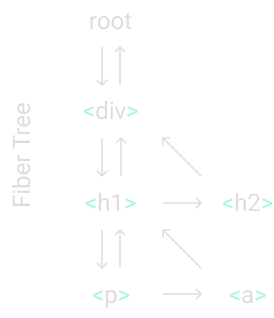
Suppose we want to render an element tree like this one:
In the render we'll create the root fiber and set it as the nextUnitOfWork. The rest of the work will happen on the performUnitOfWork function, there we will do three things for each fiber:
- add the element to the DOM
- create the fibers for the element's children
- select the next unit of work
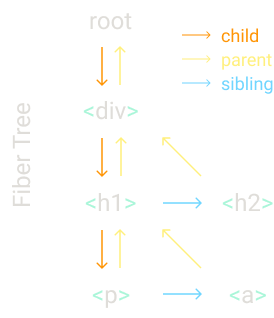
One of the goals of this data structure is to make it easy to find the next unit of work. That's why each fiber has a link to its first child, its next sibling and its parent.
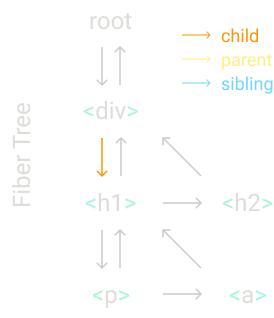
When we finish performing work on a fiber, if it has a child that fiber will be the next unit of work.
From our example, when we finish working on the div fiber the next unit of work will be the h1 fiber.
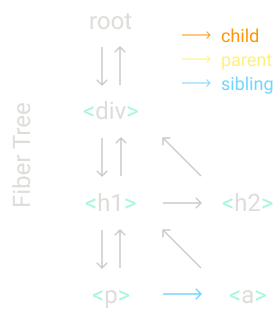
If the fiber doesn't have a child, we use the sibling as the next unit of work.
For example, the p fiber doesn't have a child so we move to the a fiber after finishing it.
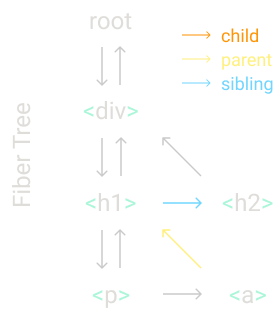
And if the fiber doesn't have a child nor a sibling we go to the "uncle": the sibling of the parent. Like a and h2 fibers from the example.
Also, if the parent doesn't have a sibling, we keep going up through the parents until we find one with a sibling or until we reach the root. If we have reached the root, it means we have finished performing all the work for this render.
Now let's put it into code.
Suppose we want to render an element tree like this one:
In the render we'll create the root fiber and set it as the nextUnitOfWork. The rest of the work will happen on the performUnitOfWork function, there we will do three things for each fiber:
- add the element to the DOM
- create the fibers for the element's children
- select the next unit of work
One of the goals of this data structure is to make it easy to find the next unit of work. That's why each fiber has a link to its first child, its next sibling and its parent.
When we finish performing work on a fiber, if it has a child that fiber will be the next unit of work.
From our example, when we finish working on the div fiber the next unit of work will be the h1 fiber.
If the fiber doesn't have a child, we use the sibling as the next unit of work.
For example, the p fiber doesn't have a child so we move to the a fiber after finishing it.
And if the fiber doesn't have a child nor a sibling we go to the "uncle": the sibling of the parent. Like a and h2 fibers from the example.
Also, if the parent doesn't have a sibling, we keep going up through the parents until we find one with a sibling or until we reach the root. If we have reached the root, it means we have finished performing all the work for this render.
Now let's put it into code.
function createElement(type, props, ...children) { return { type, props: { ...props, children: children.map(child => typeof child === "object" ? child : createTextElement(child) ), }, }} function createTextElement(text) { return { type: "TEXT_ELEMENT", props: { nodeValue: text, children: [], }, }} function render(element, container) { const dom = element.type == "TEXT_ELEMENT" ? document.createTextNode("") : document.createElement(element.type) const isProperty = key => key !== "children" Object.keys(element.props) .filter(isProperty) .forEach(name => { dom[name] = element.props[name] }) element.props.children.forEach(child => render(child, dom) ) container.appendChild(dom)} let nextUnitOfWork = null function workLoop(deadline) { let shouldYield = false while (nextUnitOfWork && !shouldYield) { nextUnitOfWork = performUnitOfWork( nextUnitOfWork ) shouldYield = deadline.timeRemaining() < 1 } requestIdleCallback(workLoop)} requestIdleCallback(workLoop) function performUnitOfWork(nextUnitOfWork) { // TODO} const Didact = { createElement, render,} /** @jsx Didact.createElement */const element = ( <div id="foo"> <a>bar</a> <b /> </div>)const container = document.getElementById("root")Didact.render(element, container) First, let's remove this code from the render function.
function createElement(type, props, ...children) { return { type, props: { ...props, children: children.map(child => typeof child === "object" ? child : createTextElement(child) ), }, }} function createTextElement(text) { return { type: "TEXT_ELEMENT", props: { nodeValue: text, children: [], }, }} function createDom(fiber) { const dom = fiber.type == "TEXT_ELEMENT" ? document.createTextNode("") : document.createElement(fiber.type) const isProperty = key => key !== "children" Object.keys(fiber.props) .filter(isProperty) .forEach(name => { dom[name] = fiber.props[name] }) return dom} function render(element, container) { // TODO set next unit of work} let nextUnitOfWork = null function workLoop(deadline) { let shouldYield = false while (nextUnitOfWork && !shouldYield) { nextUnitOfWork = performUnitOfWork( nextUnitOfWork ) shouldYield = deadline.timeRemaining() < 1 } requestIdleCallback(workLoop)} requestIdleCallback(workLoop) function performUnitOfWork(fiber) { // TODO add dom node // TODO create new fibers // TODO return next unit of work} const Didact = { createElement, render,} /** @jsx Didact.createElement */const element = ( <div id="foo"> <a>bar</a> <b /> </div>)const container = document.getElementById("root")Didact.render(element, container) We keep the part that creates a DOM node in its own function, we are going to use it later.
function createElement(type, props, ...children) { return { type, props: { ...props, children: children.map(child => typeof child === "object" ? child : createTextElement(child) ), }, }} function createTextElement(text) { return { type: "TEXT_ELEMENT", props: { nodeValue: text, children: [], }, }} function createDom(fiber) { const dom = fiber.type == "TEXT_ELEMENT" ? document.createTextNode("") : document.createElement(fiber.type) const isProperty = key => key !== "children" Object.keys(fiber.props) .filter(isProperty) .forEach(name => { dom[name] = fiber.props[name] }) return dom} function render(element, container) { nextUnitOfWork = { dom: container, props: { children: [element], }, }} let nextUnitOfWork = null function workLoop(deadline) { let shouldYield = false while (nextUnitOfWork && !shouldYield) { nextUnitOfWork = performUnitOfWork( nextUnitOfWork ) shouldYield = deadline.timeRemaining() < 1 } requestIdleCallback(workLoop)} requestIdleCallback(workLoop) function performUnitOfWork(fiber) { // TODO add dom node // TODO create new fibers // TODO return next unit of work} const Didact = { createElement, render,} /** @jsx Didact.createElement */const element = ( <div id="foo"> <a>bar</a> <b /> </div>)const container = document.getElementById("root")Didact.render(element, container) In the render function we set nextUnitOfWork to the root of the fiber tree.
function createElement(type, props, ...children) { return { type, props: { ...props, children: children.map(child => typeof child === "object" ? child : createTextElement(child) ), }, }} function createTextElement(text) { return { type: "TEXT_ELEMENT", props: { nodeValue: text, children: [], }, }} function createDom(fiber) { const dom = fiber.type == "TEXT_ELEMENT" ? document.createTextNode("") : document.createElement(fiber.type) const isProperty = key => key !== "children" Object.keys(fiber.props) .filter(isProperty) .forEach(name => { dom[name] = fiber.props[name] }) return dom} function render(element, container) { nextUnitOfWork = { dom: container, props: { children: [element], }, }} let nextUnitOfWork = null function workLoop(deadline) { let shouldYield = false while (nextUnitOfWork && !shouldYield) { nextUnitOfWork = performUnitOfWork( nextUnitOfWork ) shouldYield = deadline.timeRemaining() < 1 } requestIdleCallback(workLoop)} requestIdleCallback(workLoop) function performUnitOfWork(fiber) { // TODO add dom node // TODO create new fibers // TODO return next unit of work} const Didact = { createElement, render,} /** @jsx Didact.createElement */const element = ( <div id="foo"> <a>bar</a> <b /> </div>)const container = document.getElementById("root")Didact.render(element, container) Then, when the browser is ready,it will call our workLoop and we'll start working on the root.
function createElement(type, props, ...children) { return { type, props: { ...props, children: children.map(child => typeof child === "object" ? child : createTextElement(child) ), }, }} function createTextElement(text) { return { type: "TEXT_ELEMENT", props: { nodeValue: text, children: [], }, }} function createDom(fiber) { const dom = fiber.type == "TEXT_ELEMENT" ? document.createTextNode("") : document.createElement(fiber.type) const isProperty = key => key !== "children" Object.keys(fiber.props) .filter(isProperty) .forEach(name => { dom[name] = fiber.props[name] }) return dom} function render(element, container) { nextUnitOfWork = { dom: container, props: { children: [element], }, }} let nextUnitOfWork = null function workLoop(deadline) { let shouldYield = false while (nextUnitOfWork && !shouldYield) { nextUnitOfWork = performUnitOfWork( nextUnitOfWork ) shouldYield = deadline.timeRemaining() < 1 } requestIdleCallback(workLoop)} requestIdleCallback(workLoop) function performUnitOfWork(fiber) { if (!fiber.dom) { fiber.dom = createDom(fiber) } if (fiber.parent) { fiber.parent.dom.appendChild(fiber.dom) } // TODO create new fibers // TODO return next unit of work} const Didact = { createElement, render,} /** @jsx Didact.createElement */const element = ( <div id="foo"> <a>bar</a> <b /> </div>)const container = document.getElementById("root")Didact.render(element, container) First, we create a new node and append it to the DOM.
We keep track of the DOM node in the fiber.dom property.
function createElement(type, props, ...children) { return { type, props: { ...props, children: children.map(child => typeof child === "object" ? child : createTextElement(child) ), }, }} function createTextElement(text) { return { type: "TEXT_ELEMENT", props: { nodeValue: text, children: [], }, }} function createDom(fiber) { const dom = fiber.type == "TEXT_ELEMENT" ? document.createTextNode("") : document.createElement(fiber.type) const isProperty = key => key !== "children" Object.keys(fiber.props) .filter(isProperty) .forEach(name => { dom[name] = fiber.props[name] }) return dom} function render(element, container) { nextUnitOfWork = { dom: container, props: { children: [element], }, }} let nextUnitOfWork = null function workLoop(deadline) { let shouldYield = false while (nextUnitOfWork && !shouldYield) { nextUnitOfWork = performUnitOfWork( nextUnitOfWork ) shouldYield = deadline.timeRemaining() < 1 } requestIdleCallback(workLoop)} requestIdleCallback(workLoop) function performUnitOfWork(fiber) { if (!fiber.dom) { fiber.dom = createDom(fiber) } if (fiber.parent) { fiber.parent.dom.appendChild(fiber.dom) } const elements = fiber.props.children let index = 0 let prevSibling = null while (index < elements.length) { const element = elements[index] const newFiber = { type: element.type, props: element.props, parent: fiber, dom: null, } } // TODO return next unit of work} const Didact = { createElement, render,} /** @jsx Didact.createElement */const element = ( <div id="foo"> <a>bar</a> <b /> </div>)const container = document.getElementById("root")Didact.render(element, container) Then for each child we create a new fiber.
function createElement(type, props, ...children) { return { type, props: { ...props, children: children.map(child => typeof child === "object" ? child : createTextElement(child) ), }, }} function createTextElement(text) { return { type: "TEXT_ELEMENT", props: { nodeValue: text, children: [], }, }} function createDom(fiber) { const dom = fiber.type == "TEXT_ELEMENT" ? document.createTextNode("") : document.createElement(fiber.type) const isProperty = key => key !== "children" Object.keys(fiber.props) .filter(isProperty) .forEach(name => { dom[name] = fiber.props[name] }) return dom} function render(element, container) { nextUnitOfWork = { dom: container, props: { children: [element], }, }} let nextUnitOfWork = null function workLoop(deadline) { let shouldYield = false while (nextUnitOfWork && !shouldYield) { nextUnitOfWork = performUnitOfWork( nextUnitOfWork ) shouldYield = deadline.timeRemaining() < 1 } requestIdleCallback(workLoop)} requestIdleCallback(workLoop) function performUnitOfWork(fiber) { if (!fiber.dom) { fiber.dom = createDom(fiber) } if (fiber.parent) { fiber.parent.dom.appendChild(fiber.dom) } const elements = fiber.props.children let index = 0 let prevSibling = null while (index < elements.length) { const element = elements[index] const newFiber = { type: element.type, props: element.props, parent: fiber, dom: null, } if (index === 0) { fiber.child = newFiber } else { prevSibling.sibling = newFiber } prevSibling = newFiber index++ } // TODO return next unit of work} const Didact = { createElement, render,} /** @jsx Didact.createElement */const element = ( <div id="foo"> <a>bar</a> <b /> </div>)const container = document.getElementById("root")Didact.render(element, container) And we add it to the fiber tree setting it either as a child or as a sibling, depending on whether it's the first child or not.
function createElement(type, props, ...children) { return { type, props: { ...props, children: children.map(child => typeof child === "object" ? child : createTextElement(child) ), }, }} function createTextElement(text) { return { type: "TEXT_ELEMENT", props: { nodeValue: text, children: [], }, }} function createDom(fiber) { const dom = fiber.type == "TEXT_ELEMENT" ? document.createTextNode("") : document.createElement(fiber.type) const isProperty = key => key !== "children" Object.keys(fiber.props) .filter(isProperty) .forEach(name => { dom[name] = fiber.props[name] }) return dom} function render(element, container) { nextUnitOfWork = { dom: container, props: { children: [element], }, }} let nextUnitOfWork = null function workLoop(deadline) { let shouldYield = false while (nextUnitOfWork && !shouldYield) { nextUnitOfWork = performUnitOfWork( nextUnitOfWork ) shouldYield = deadline.timeRemaining() < 1 } requestIdleCallback(workLoop)} requestIdleCallback(workLoop) function performUnitOfWork(fiber) { if (!fiber.dom) { fiber.dom = createDom(fiber) } if (fiber.parent) { fiber.parent.dom.appendChild(fiber.dom) } const elements = fiber.props.children let index = 0 let prevSibling = null while (index < elements.length) { const element = elements[index] const newFiber = { type: element.type, props: element.props, parent: fiber, dom: null, } if (index === 0) { fiber.child = newFiber } else { prevSibling.sibling = newFiber } prevSibling = newFiber index++ } if (fiber.child) { return fiber.child } let nextFiber = fiber while (nextFiber) { if (nextFiber.sibling) { return nextFiber.sibling } nextFiber = nextFiber.parent }} const Didact = { createElement, render,} /** @jsx Didact.createElement */const element = ( <div id="foo"> <a>bar</a> <b /> </div>)const container = document.getElementById("root")Didact.render(element, container) Finally we search for the next unit of work. We first try with the child, then with the sibling, then with the uncle, and so on.
function createElement(type, props, ...children) { return { type, props: { ...props, children: children.map(child => typeof child === "object" ? child : createTextElement(child) ), }, }} function createTextElement(text) { return { type: "TEXT_ELEMENT", props: { nodeValue: text, children: [], }, }} function createDom(fiber) { const dom = fiber.type == "TEXT_ELEMENT" ? document.createTextNode("") : document.createElement(fiber.type) const isProperty = key => key !== "children" Object.keys(fiber.props) .filter(isProperty) .forEach(name => { dom[name] = fiber.props[name] }) return dom} function render(element, container) { nextUnitOfWork = { dom: container, props: { children: [element], }, }} let nextUnitOfWork = null function workLoop(deadline) { let shouldYield = false while (nextUnitOfWork && !shouldYield) { nextUnitOfWork = performUnitOfWork( nextUnitOfWork ) shouldYield = deadline.timeRemaining() < 1 } requestIdleCallback(workLoop)} requestIdleCallback(workLoop) function performUnitOfWork(fiber) { if (!fiber.dom) { fiber.dom = createDom(fiber) } if (fiber.parent) { fiber.parent.dom.appendChild(fiber.dom) } const elements = fiber.props.children let index = 0 let prevSibling = null while (index < elements.length) { const element = elements[index] const newFiber = { type: element.type, props: element.props, parent: fiber, dom: null, } if (index === 0) { fiber.child = newFiber } else { prevSibling.sibling = newFiber } prevSibling = newFiber index++ } if (fiber.child) { return fiber.child } let nextFiber = fiber while (nextFiber) { if (nextFiber.sibling) { return nextFiber.sibling } nextFiber = nextFiber.parent }} const Didact = { createElement, render,} /** @jsx Didact.createElement */const element = ( <div id="foo"> <a>bar</a> <b /> </div>)const container = document.getElementById("root")Didact.render(element, container) And that's our performUnitOfWork.
function createElement(type, props, ...children) { return { type, props: { ...props, children: children.map(child => typeof child === "object" ? child : createTextElement(child) ), }, }} function createTextElement(text) { return { type: "TEXT_ELEMENT", props: { nodeValue: text, children: [], }, }} function createDom(fiber) { const dom = fiber.type == "TEXT_ELEMENT" ? document.createTextNode("") : document.createElement(fiber.type) const isProperty = key => key !== "children" Object.keys(fiber.props) .filter(isProperty) .forEach(name => { dom[name] = fiber.props[name] }) return dom} function render(element, container) { nextUnitOfWork = { dom: container, props: { children: [element], }, }} let nextUnitOfWork = null function workLoop(deadline) { let shouldYield = false while (nextUnitOfWork && !shouldYield) { nextUnitOfWork = performUnitOfWork( nextUnitOfWork ) shouldYield = deadline.timeRemaining() < 1 } requestIdleCallback(workLoop)} requestIdleCallback(workLoop) function performUnitOfWork(fiber) { if (!fiber.dom) { fiber.dom = createDom(fiber) } if (fiber.parent) { fiber.parent.dom.appendChild(fiber.dom) } const elements = fiber.props.children let index = 0 let prevSibling = null while (index < elements.length) { const element = elements[index] const newFiber = { type: element.type, props: element.props, parent: fiber, dom: null, } if (index === 0) { fiber.child = newFiber } else { prevSibling.sibling = newFiber } prevSibling = newFiber index++ } if (fiber.child) { return fiber.child } let nextFiber = fiber while (nextFiber) { if (nextFiber.sibling) { return nextFiber.sibling } nextFiber = nextFiber.parent }} const Didact = { createElement, render,} /** @jsx Didact.createElement */const element = ( <div id="foo"> <a>bar</a> <b /> </div>)const container = document.getElementById("root")Didact.render(element, container) Step V: Render and Commit Phases
We have another problem here.
We are adding a new node to the DOM each time we work on an element. And, remember, the browser could interrupt our work before we finish rendering the whole tree. In that case, the user will see an incomplete UI. And we don't want that.
function createElement(type, props, ...children) { return { type, props: { ...props, children: children.map(child => typeof child === "object" ? child : createTextElement(child) ), }, }} function createTextElement(text) { return { type: "TEXT_ELEMENT", props: { nodeValue: text, children: [], }, }} function createDom(fiber) { const dom = fiber.type == "TEXT_ELEMENT" ? document.createTextNode("") : document.createElement(fiber.type) const isProperty = key => key !== "children" Object.keys(fiber.props) .filter(isProperty) .forEach(name => { dom[name] = fiber.props[name] }) return dom} function render(element, container) { nextUnitOfWork = { dom: container, props: { children: [element], }, }} let nextUnitOfWork = null function workLoop(deadline) { let shouldYield = false while (nextUnitOfWork && !shouldYield) { nextUnitOfWork = performUnitOfWork( nextUnitOfWork ) shouldYield = deadline.timeRemaining() < 1 } requestIdleCallback(workLoop)} requestIdleCallback(workLoop) function performUnitOfWork(fiber) { if (!fiber.dom) { fiber.dom = createDom(fiber) } const elements = fiber.props.children let index = 0 let prevSibling = null while (index < elements.length) { const element = elements[index] const newFiber = { type: element.type, props: element.props, parent: fiber, dom: null, } if (index === 0) { fiber.child = newFiber } else { prevSibling.sibling = newFiber } prevSibling = newFiber index++ } if (fiber.child) { return fiber.child } let nextFiber = fiber while (nextFiber) { if (nextFiber.sibling) { return nextFiber.sibling } nextFiber = nextFiber.parent }} const Didact = { createElement, render,} /** @jsx Didact.createElement */const element = ( <div id="foo"> <a>bar</a> <b /> </div>)const container = document.getElementById("root")Didact.render(element, container) So we need to remove the part that mutates the DOM from here.
function createElement(type, props, ...children) { return { type, props: { ...props, children: children.map(child => typeof child === "object" ? child : createTextElement(child) ), }, }} function createTextElement(text) { return { type: "TEXT_ELEMENT", props: { nodeValue: text, children: [], }, }} function createDom(fiber) { const dom = fiber.type == "TEXT_ELEMENT" ? document.createTextNode("") : document.createElement(fiber.type) const isProperty = key => key !== "children" Object.keys(fiber.props) .filter(isProperty) .forEach(name => { dom[name] = fiber.props[name] }) return dom} function render(element, container) { wipRoot = { dom: container, props: { children: [element], }, } nextUnitOfWork = wipRoot} let nextUnitOfWork = nulllet wipRoot = null function workLoop(deadline) { let shouldYield = false while (nextUnitOfWork && !shouldYield) { nextUnitOfWork = performUnitOfWork( nextUnitOfWork ) shouldYield = deadline.timeRemaining() < 1 } requestIdleCallback(workLoop)} requestIdleCallback(workLoop) function performUnitOfWork(fiber) { if (!fiber.dom) { fiber.dom = createDom(fiber) } const elements = fiber.props.children let index = 0 let prevSibling = null while (index < elements.length) { const element = elements[index] const newFiber = { type: element.type, props: element.props, parent: fiber, dom: null, } if (index === 0) { fiber.child = newFiber } else { prevSibling.sibling = newFiber } prevSibling = newFiber index++ } if (fiber.child) { return fiber.child } let nextFiber = fiber while (nextFiber) { if (nextFiber.sibling) { return nextFiber.sibling } nextFiber = nextFiber.parent }} const Didact = { createElement, render,} /** @jsx Didact.createElement */const element = ( <div id="foo"> <a>bar</a> <b /> </div>)const container = document.getElementById("root")Didact.render(element, container) Instead, we'll keep track of the root of the fiber tree. We call it the work in progress root or wipRoot.
function createElement(type, props, ...children) { return { type, props: { ...props, children: children.map(child => typeof child === "object" ? child : createTextElement(child) ), }, }} function createTextElement(text) { return { type: "TEXT_ELEMENT", props: { nodeValue: text, children: [], }, }} function createDom(fiber) { const dom = fiber.type == "TEXT_ELEMENT" ? document.createTextNode("") : document.createElement(fiber.type) const isProperty = key => key !== "children" Object.keys(fiber.props) .filter(isProperty) .forEach(name => { dom[name] = fiber.props[name] }) return dom} function commitRoot() { // TODO add nodes to dom} function render(element, container) { wipRoot = { dom: container, props: { children: [element], }, } nextUnitOfWork = wipRoot} let nextUnitOfWork = nulllet wipRoot = null function workLoop(deadline) { let shouldYield = false while (nextUnitOfWork && !shouldYield) { nextUnitOfWork = performUnitOfWork( nextUnitOfWork ) shouldYield = deadline.timeRemaining() < 1 } if (!nextUnitOfWork && wipRoot) { commitRoot() } requestIdleCallback(workLoop)} requestIdleCallback(workLoop) function performUnitOfWork(fiber) { if (!fiber.dom) { fiber.dom = createDom(fiber) } const elements = fiber.props.children let index = 0 let prevSibling = null while (index < elements.length) { const element = elements[index] const newFiber = { type: element.type, props: element.props, parent: fiber, dom: null, } if (index === 0) { fiber.child = newFiber } else { prevSibling.sibling = newFiber } prevSibling = newFiber index++ } if (fiber.child) { return fiber.child } let nextFiber = fiber while (nextFiber) { if (nextFiber.sibling) { return nextFiber.sibling } nextFiber = nextFiber.parent }} const Didact = { createElement, render,} /** @jsx Didact.createElement */const element = ( <div id="foo"> <a>bar</a> <b /> </div>)const container = document.getElementById("root")Didact.render(element, container) And once we finish all the work (we know it because there isn't a next unit of work) we commit the whole fiber tree to the DOM.
function createElement(type, props, ...children) { return { type, props: { ...props, children: children.map(child => typeof child === "object" ? child : createTextElement(child) ), }, }} function createTextElement(text) { return { type: "TEXT_ELEMENT", props: { nodeValue: text, children: [], }, }} function createDom(fiber) { const dom = fiber.type == "TEXT_ELEMENT" ? document.createTextNode("") : document.createElement(fiber.type) const isProperty = key => key !== "children" Object.keys(fiber.props) .filter(isProperty) .forEach(name => { dom[name] = fiber.props[name] }) return dom} function commitRoot() { commitWork(wipRoot.child) wipRoot = null} function commitWork(fiber) { if (!fiber) { return } const domParent = fiber.parent.dom domParent.appendChild(fiber.dom) commitWork(fiber.child) commitWork(fiber.sibling)} function render(element, container) { wipRoot = { dom: container, props: { children: [element], }, } nextUnitOfWork = wipRoot} let nextUnitOfWork = nulllet wipRoot = null function workLoop(deadline) { let shouldYield = false while (nextUnitOfWork && !shouldYield) { nextUnitOfWork = performUnitOfWork( nextUnitOfWork ) shouldYield = deadline.timeRemaining() < 1 } if (!nextUnitOfWork && wipRoot) { commitRoot() } requestIdleCallback(workLoop)} requestIdleCallback(workLoop) function performUnitOfWork(fiber) { if (!fiber.dom) { fiber.dom = createDom(fiber) } const elements = fiber.props.children let index = 0 let prevSibling = null while (index < elements.length) { const element = elements[index] const newFiber = { type: element.type, props: element.props, parent: fiber, dom: null, } if (index === 0) { fiber.child = newFiber } else { prevSibling.sibling = newFiber } prevSibling = newFiber index++ } if (fiber.child) { return fiber.child } let nextFiber = fiber while (nextFiber) { if (nextFiber.sibling) { return nextFiber.sibling } nextFiber = nextFiber.parent }} const Didact = { createElement, render,} /** @jsx Didact.createElement */const element = ( <div id="foo"> <a>bar</a> <b /> </div>)const container = document.getElementById("root")Didact.render(element, container) We do it in the commitRoot function. Here we recursively append all the nodes to the dom.
Step VI: Reconciliation
So far we only added stuff to the DOM, but what about updating or deleting nodes?
That's what we are going to do now, we need to compare the elements we receive on the render function to the last fiber tree we committed to the DOM.
function createElement(type, props, ...children) { return { type, props: { ...props, children: children.map(child => typeof child === "object" ? child : createTextElement(child) ), }, }} function createTextElement(text) { return { type: "TEXT_ELEMENT", props: { nodeValue: text, children: [], }, }} function createDom(fiber) { const dom = fiber.type == "TEXT_ELEMENT" ? document.createTextNode("") : document.createElement(fiber.type) const isProperty = key => key !== "children" Object.keys(fiber.props) .filter(isProperty) .forEach(name => { dom[name] = fiber.props[name] }) return dom} function commitRoot() { commitWork(wipRoot.child) currentRoot = wipRoot wipRoot = null} function commitWork(fiber) { if (!fiber) { return } const domParent = fiber.parent.dom domParent.appendChild(fiber.dom) commitWork(fiber.child) commitWork(fiber.sibling)} function render(element, container) { wipRoot = { dom: container, props: { children: [element], }, alternate: currentRoot, } nextUnitOfWork = wipRoot} let nextUnitOfWork = nulllet currentRoot = nulllet wipRoot = null function workLoop(deadline) { let shouldYield = false while (nextUnitOfWork && !shouldYield) { nextUnitOfWork = performUnitOfWork( nextUnitOfWork ) shouldYield = deadline.timeRemaining() < 1 } if (!nextUnitOfWork && wipRoot) { commitRoot() } requestIdleCallback(workLoop)} requestIdleCallback(workLoop) function performUnitOfWork(fiber) { if (!fiber.dom) { fiber.dom = createDom(fiber) } const elements = fiber.props.children let index = 0 let prevSibling = null while (index < elements.length) { const element = elements[index] const newFiber = { type: element.type, props: element.props, parent: fiber, dom: null, } if (index === 0) { fiber.child = newFiber } else { prevSibling.sibling = newFiber } prevSibling = newFiber index++ } if (fiber.child) { return fiber.child } let nextFiber = fiber while (nextFiber) { if (nextFiber.sibling) { return nextFiber.sibling } nextFiber = nextFiber.parent }} const Didact = { createElement, render,} /** @jsx Didact.createElement */const element = ( <div id="foo"> <a>bar</a> <b /> </div>)const container = document.getElementById("root")Didact.render(element, container) So we need to save a reference to that "last fiber tree we committed to the DOM" after we finish the commit. We call it currentRoot.
We also add the alternate property to every fiber. This property is a link to the old fiber, the fiber that we committed to the DOM in the previous commit phase.
function createElement(type, props, ...children) { return { type, props: { ...props, children: children.map(child => typeof child === "object" ? child : createTextElement(child) ), }, }} function createTextElement(text) { return { type: "TEXT_ELEMENT", props: { nodeValue: text, children: [], }, }} function createDom(fiber) { const dom = fiber.type == "TEXT_ELEMENT" ? document.createTextNode("") : document.createElement(fiber.type) const isProperty = key => key !== "children" Object.keys(fiber.props) .filter(isProperty) .forEach(name => { dom[name] = fiber.props[name] }) return dom} function commitRoot() { commitWork(wipRoot.child) currentRoot = wipRoot wipRoot = null} function commitWork(fiber) { if (!fiber) { return } const domParent = fiber.parent.dom domParent.appendChild(fiber.dom) commitWork(fiber.child) commitWork(fiber.sibling)} function render(element, container) { wipRoot = { dom: container, props: { children: [element], }, alternate: currentRoot, } nextUnitOfWork = wipRoot} let nextUnitOfWork = nulllet currentRoot = nulllet wipRoot = null function workLoop(deadline) { let shouldYield = false while (nextUnitOfWork && !shouldYield) { nextUnitOfWork = performUnitOfWork( nextUnitOfWork ) shouldYield = deadline.timeRemaining() < 1 } if (!nextUnitOfWork && wipRoot) { commitRoot() } requestIdleCallback(workLoop)} requestIdleCallback(workLoop) function performUnitOfWork(fiber) { if (!fiber.dom) { fiber.dom = createDom(fiber) } const elements = fiber.props.children let index = 0 let prevSibling = null while (index < elements.length) { const element = elements[index] const newFiber = { type: element.type, props: element.props, parent: fiber, dom: null, } if (index === 0) { fiber.child = newFiber } else { prevSibling.sibling = newFiber } prevSibling = newFiber index++ } if (fiber.child) { return fiber.child } let nextFiber = fiber while (nextFiber) { if (nextFiber.sibling) { return nextFiber.sibling } nextFiber = nextFiber.parent }} const Didact = { createElement, render,} /** @jsx Didact.createElement */const element = ( <div id="foo"> <a>bar</a> <b /> </div>)const container = document.getElementById("root")Didact.render(element, container) Now let's extract the code from performUnitOfWork that creates the new fibers...
function createElement(type, props, ...children) { return { type, props: { ...props, children: children.map(child => typeof child === "object" ? child : createTextElement(child) ), }, }} function createTextElement(text) { return { type: "TEXT_ELEMENT", props: { nodeValue: text, children: [], }, }} function createDom(fiber) { const dom = fiber.type == "TEXT_ELEMENT" ? document.createTextNode("") : document.createElement(fiber.type) const isProperty = key => key !== "children" Object.keys(fiber.props) .filter(isProperty) .forEach(name => { dom[name] = fiber.props[name] }) return dom} function commitRoot() { commitWork(wipRoot.child) currentRoot = wipRoot wipRoot = null} function commitWork(fiber) { if (!fiber) { return } const domParent = fiber.parent.dom domParent.appendChild(fiber.dom) commitWork(fiber.child) commitWork(fiber.sibling)} function render(element, container) { wipRoot = { dom: container, props: { children: [element], }, alternate: currentRoot, } nextUnitOfWork = wipRoot} let nextUnitOfWork = nulllet currentRoot = nulllet wipRoot = null function workLoop(deadline) { let shouldYield = false while (nextUnitOfWork && !shouldYield) { nextUnitOfWork = performUnitOfWork( nextUnitOfWork ) shouldYield = deadline.timeRemaining() < 1 } if (!nextUnitOfWork && wipRoot) { commitRoot() } requestIdleCallback(workLoop)} requestIdleCallback(workLoop) function performUnitOfWork(fiber) { if (!fiber.dom) { fiber.dom = createDom(fiber) } const elements = fiber.props.children reconcileChildren(fiber, elements) if (fiber.child) { return fiber.child } let nextFiber = fiber while (nextFiber) { if (nextFiber.sibling) { return nextFiber.sibling } nextFiber = nextFiber.parent }} function reconcileChildren(wipFiber, elements) { let index = 0 let prevSibling = null while (index < elements.length) { const element = elements[index] const newFiber = { type: element.type, props: element.props, parent: wipFiber, dom: null, } if (index === 0) { wipFiber.child = newFiber } else { prevSibling.sibling = newFiber } prevSibling = newFiber index++ }} const Didact = { createElement, render,} /** @jsx Didact.createElement */const element = ( <div id="foo"> <a>bar</a> <b /> </div>)const container = document.getElementById("root")Didact.render(element, container) ...to a new reconcileChildren function.
function createElement(type, props, ...children) { return { type, props: { ...props, children: children.map(child => typeof child === "object" ? child : createTextElement(child) ), }, }} function createTextElement(text) { return { type: "TEXT_ELEMENT", props: { nodeValue: text, children: [], }, }} function createDom(fiber) { const dom = fiber.type == "TEXT_ELEMENT" ? document.createTextNode("") : document.createElement(fiber.type) const isProperty = key => key !== "children" Object.keys(fiber.props) .filter(isProperty) .forEach(name => { dom[name] = fiber.props[name] }) return dom} function commitRoot() { commitWork(wipRoot.child) currentRoot = wipRoot wipRoot = null} function commitWork(fiber) { if (!fiber) { return } const domParent = fiber.parent.dom domParent.appendChild(fiber.dom) commitWork(fiber.child) commitWork(fiber.sibling)} function render(element, container) { wipRoot = { dom: container, props: { children: [element], }, alternate: currentRoot, } nextUnitOfWork = wipRoot} let nextUnitOfWork = nulllet currentRoot = nulllet wipRoot = null function workLoop(deadline) { let shouldYield = false while (nextUnitOfWork && !shouldYield) { nextUnitOfWork = performUnitOfWork( nextUnitOfWork ) shouldYield = deadline.timeRemaining() < 1 } if (!nextUnitOfWork && wipRoot) { commitRoot() } requestIdleCallback(workLoop)} requestIdleCallback(workLoop) function performUnitOfWork(fiber) { if (!fiber.dom) { fiber.dom = createDom(fiber) } const elements = fiber.props.children reconcileChildren(fiber, elements) if (fiber.child) { return fiber.child } let nextFiber = fiber while (nextFiber) { if (nextFiber.sibling) { return nextFiber.sibling } nextFiber = nextFiber.parent }} function reconcileChildren(wipFiber, elements) { let index = 0 let prevSibling = null while (index < elements.length) { const element = elements[index] const newFiber = { type: element.type, props: element.props, parent: wipFiber, dom: null, } if (index === 0) { wipFiber.child = newFiber } else { prevSibling.sibling = newFiber } prevSibling = newFiber index++ }} const Didact = { createElement, render,} /** @jsx Didact.createElement */const element = ( <div id="foo"> <a>bar</a> <b /> </div>)const container = document.getElementById("root")Didact.render(element, container) Here we will reconcile the old fibers with the new elements.
function createElement(type, props, ...children) { return { type, props: { ...props, children: children.map(child => typeof child === "object" ? child : createTextElement(child) ), }, }} function createTextElement(text) { return { type: "TEXT_ELEMENT", props: { nodeValue: text, children: [], }, }} function createDom(fiber) { const dom = fiber.type == "TEXT_ELEMENT" ? document.createTextNode("") : document.createElement(fiber.type) const isProperty = key => key !== "children" Object.keys(fiber.props) .filter(isProperty) .forEach(name => { dom[name] = fiber.props[name] }) return dom} function commitRoot() { commitWork(wipRoot.child) currentRoot = wipRoot wipRoot = null} function commitWork(fiber) { if (!fiber) { return } const domParent = fiber.parent.dom domParent.appendChild(fiber.dom) commitWork(fiber.child) commitWork(fiber.sibling)} function render(element, container) { wipRoot = { dom: container, props: { children: [element], }, alternate: currentRoot, } nextUnitOfWork = wipRoot} let nextUnitOfWork = nulllet currentRoot = nulllet wipRoot = null function workLoop(deadline) { let shouldYield = false while (nextUnitOfWork && !shouldYield) { nextUnitOfWork = performUnitOfWork( nextUnitOfWork ) shouldYield = deadline.timeRemaining() < 1 } if (!nextUnitOfWork && wipRoot) { commitRoot() } requestIdleCallback(workLoop)} requestIdleCallback(workLoop) function performUnitOfWork(fiber) { if (!fiber.dom) { fiber.dom = createDom(fiber) } const elements = fiber.props.children reconcileChildren(fiber, elements) if (fiber.child) { return fiber.child } let nextFiber = fiber while (nextFiber) { if (nextFiber.sibling) { return nextFiber.sibling } nextFiber = nextFiber.parent }} function reconcileChildren(wipFiber, elements) { let index = 0 let oldFiber = wipFiber.alternate && wipFiber.alternate.child let prevSibling = null while ( index < elements.length || oldFiber != null ) { const element = elements[index] let newFiber = null // TODO compare oldFiber to element if (oldFiber) { oldFiber = oldFiber.sibling } if (index === 0) { wipFiber.child = newFiber } else if (element) { prevSibling.sibling = newFiber } prevSibling = newFiber index++ }} const Didact = { createElement, render,} /** @jsx Didact.createElement */const element = ( <div id="foo"> <a>bar</a> <b /> </div>)const container = document.getElementById("root")Didact.render(element, container) We iterate at the same time over the children of the old fiber (wipFiber.alternate) and the array of elements we want to reconcile.
If we ignore all the boilerplate needed to iterate over an array and a linked list at the same time, we are left with what matters most inside this while: oldFiber and element. The element is the thing we want to render to the DOM and the oldFiber is what we rendered the last time.
We need to compare them to see if there's any change we need to apply to the DOM.
function createElement(type, props, ...children) { return { type, props: { ...props, children: children.map(child => typeof child === "object" ? child : createTextElement(child) ), }, }} function createTextElement(text) { return { type: "TEXT_ELEMENT", props: { nodeValue: text, children: [], }, }} function createDom(fiber) { const dom = fiber.type == "TEXT_ELEMENT" ? document.createTextNode("") : document.createElement(fiber.type) const isProperty = key => key !== "children" Object.keys(fiber.props) .filter(isProperty) .forEach(name => { dom[name] = fiber.props[name] }) return dom} function commitRoot() { commitWork(wipRoot.child) currentRoot = wipRoot wipRoot = null} function commitWork(fiber) { if (!fiber) { return } const domParent = fiber.parent.dom domParent.appendChild(fiber.dom) commitWork(fiber.child) commitWork(fiber.sibling)} function render(element, container) { wipRoot = { dom: container, props: { children: [element], }, alternate: currentRoot, } nextUnitOfWork = wipRoot} let nextUnitOfWork = nulllet currentRoot = nulllet wipRoot = null function workLoop(deadline) { let shouldYield = false while (nextUnitOfWork && !shouldYield) { nextUnitOfWork = performUnitOfWork( nextUnitOfWork ) shouldYield = deadline.timeRemaining() < 1 } if (!nextUnitOfWork && wipRoot) { commitRoot() } requestIdleCallback(workLoop)} requestIdleCallback(workLoop) function performUnitOfWork(fiber) { if (!fiber.dom) { fiber.dom = createDom(fiber) } const elements = fiber.props.children reconcileChildren(fiber, elements) if (fiber.child) { return fiber.child } let nextFiber = fiber while (nextFiber) { if (nextFiber.sibling) { return nextFiber.sibling } nextFiber = nextFiber.parent }} function reconcileChildren(wipFiber, elements) { let index = 0 let oldFiber = wipFiber.alternate && wipFiber.alternate.child let prevSibling = null while ( index < elements.length || oldFiber != null ) { const element = elements[index] let newFiber = null const sameType = oldFiber && element && element.type == oldFiber.type if (sameType) { // TODO update the node } if (element && !sameType) { // TODO add this node } if (oldFiber && !sameType) { // TODO delete the oldFiber's node } if (oldFiber) { oldFiber = oldFiber.sibling } if (index === 0) { wipFiber.child = newFiber } else if (element) { prevSibling.sibling = newFiber } prevSibling = newFiber index++ }} const Didact = { createElement, render,} /** @jsx Didact.createElement */const element = ( <div id="foo"> <a>bar</a> <b /> </div>)const container = document.getElementById("root")Didact.render(element, container) To compare them we use the type:
-
if the old fiber and the new element have the same type, we can keep the DOM node and just update it with the new props
-
if the type is different and there is a new element, it means we need to create a new DOM node
-
and if the types are different and there is an old fiber, we need to remove the old node
Here React also uses keys, that makes a better reconciliation. For example, it detects when children change places in the element array.
function createElement(type, props, ...children) { return { type, props: { ...props, children: children.map(child => typeof child === "object" ? child : createTextElement(child) ), }, }} function createTextElement(text) { return { type: "TEXT_ELEMENT", props: { nodeValue: text, children: [], }, }} function createDom(fiber) { const dom = fiber.type == "TEXT_ELEMENT" ? document.createTextNode("") : document.createElement(fiber.type) const isProperty = key => key !== "children" Object.keys(fiber.props) .filter(isProperty) .forEach(name => { dom[name] = fiber.props[name] }) return dom} function commitRoot() { commitWork(wipRoot.child) currentRoot = wipRoot wipRoot = null} function commitWork(fiber) { if (!fiber) { return } const domParent = fiber.parent.dom domParent.appendChild(fiber.dom) commitWork(fiber.child) commitWork(fiber.sibling)} function render(element, container) { wipRoot = { dom: container, props: { children: [element], }, alternate: currentRoot, } nextUnitOfWork = wipRoot} let nextUnitOfWork = nulllet currentRoot = nulllet wipRoot = null function workLoop(deadline) { let shouldYield = false while (nextUnitOfWork && !shouldYield) { nextUnitOfWork = performUnitOfWork( nextUnitOfWork ) shouldYield = deadline.timeRemaining() < 1 } if (!nextUnitOfWork && wipRoot) { commitRoot() } requestIdleCallback(workLoop)} requestIdleCallback(workLoop) function performUnitOfWork(fiber) { if (!fiber.dom) { fiber.dom = createDom(fiber) } const elements = fiber.props.children reconcileChildren(fiber, elements) if (fiber.child) { return fiber.child } let nextFiber = fiber while (nextFiber) { if (nextFiber.sibling) { return nextFiber.sibling } nextFiber = nextFiber.parent }} function reconcileChildren(wipFiber, elements) { let index = 0 let oldFiber = wipFiber.alternate && wipFiber.alternate.child let prevSibling = null while ( index < elements.length || oldFiber != null ) { const element = elements[index] let newFiber = null const sameType = oldFiber && element && element.type == oldFiber.type if (sameType) { newFiber = { type: oldFiber.type, props: element.props, dom: oldFiber.dom, parent: wipFiber, alternate: oldFiber, effectTag: "UPDATE", } } if (element && !sameType) { // TODO add this node } if (oldFiber && !sameType) { // TODO delete the oldFiber's node } if (oldFiber) { oldFiber = oldFiber.sibling } if (index === 0) { wipFiber.child = newFiber } else if (element) { prevSibling.sibling = newFiber } prevSibling = newFiber index++ }} const Didact = { createElement, render,} /** @jsx Didact.createElement */const element = ( <div id="foo"> <a>bar</a> <b /> </div>)const container = document.getElementById("root")Didact.render(element, container) When the old fiber and the element have the same type, we create a new fiber keeping the DOM node from the old fiber and the props from the element.
We also add a new property to the fiber: the effectTag. We'll use this property later, during the commit phase.
function createElement(type, props, ...children) { return { type, props: { ...props, children: children.map(child => typeof child === "object" ? child : createTextElement(child) ), }, }} function createTextElement(text) { return { type: "TEXT_ELEMENT", props: { nodeValue: text, children: [], }, }} function createDom(fiber) { const dom = fiber.type == "TEXT_ELEMENT" ? document.createTextNode("") : document.createElement(fiber.type) const isProperty = key => key !== "children" Object.keys(fiber.props) .filter(isProperty) .forEach(name => { dom[name] = fiber.props[name] }) return dom} function commitRoot() { commitWork(wipRoot.child) currentRoot = wipRoot wipRoot = null} function commitWork(fiber) { if (!fiber) { return } const domParent = fiber.parent.dom domParent.appendChild(fiber.dom) commitWork(fiber.child) commitWork(fiber.sibling)} function render(element, container) { wipRoot = { dom: container, props: { children: [element], }, alternate: currentRoot, } nextUnitOfWork = wipRoot} let nextUnitOfWork = nulllet currentRoot = nulllet wipRoot = null function workLoop(deadline) { let shouldYield = false while (nextUnitOfWork && !shouldYield) { nextUnitOfWork = performUnitOfWork( nextUnitOfWork ) shouldYield = deadline.timeRemaining() < 1 } if (!nextUnitOfWork && wipRoot) { commitRoot() } requestIdleCallback(workLoop)} requestIdleCallback(workLoop) function performUnitOfWork(fiber) { if (!fiber.dom) { fiber.dom = createDom(fiber) } const elements = fiber.props.children reconcileChildren(fiber, elements) if (fiber.child) { return fiber.child } let nextFiber = fiber while (nextFiber) { if (nextFiber.sibling) { return nextFiber.sibling } nextFiber = nextFiber.parent }} function reconcileChildren(wipFiber, elements) { let index = 0 let oldFiber = wipFiber.alternate && wipFiber.alternate.child let prevSibling = null while ( index < elements.length || oldFiber != null ) { const element = elements[index] let newFiber = null const sameType = oldFiber && element && element.type == oldFiber.type if (sameType) { newFiber = { type: oldFiber.type, props: element.props, dom: oldFiber.dom, parent: wipFiber, alternate: oldFiber, effectTag: "UPDATE", } } if (element && !sameType) { newFiber = { type: element.type, props: element.props, dom: null, parent: wipFiber, alternate: null, effectTag: "PLACEMENT", } } if (oldFiber && !sameType) { // TODO delete the oldFiber's node } if (oldFiber) { oldFiber = oldFiber.sibling } if (index === 0) { wipFiber.child = newFiber } else if (element) { prevSibling.sibling = newFiber } prevSibling = newFiber index++ }} const Didact = { createElement, render,} /** @jsx Didact.createElement */const element = ( <div id="foo"> <a>bar</a> <b /> </div>)const container = document.getElementById("root")Didact.render(element, container) Then for the case where the element needs a new DOM node we tag the new fiber with the PLACEMENT effect tag.
function createElement(type, props, ...children) { return { type, props: { ...props, children: children.map(child => typeof child === "object" ? child : createTextElement(child) ), }, }} function createTextElement(text) { return { type: "TEXT_ELEMENT", props: { nodeValue: text, children: [], }, }} function createDom(fiber) { const dom = fiber.type == "TEXT_ELEMENT" ? document.createTextNode("") : document.createElement(fiber.type) const isProperty = key => key !== "children" Object.keys(fiber.props) .filter(isProperty) .forEach(name => { dom[name] = fiber.props[name] }) return dom} function commitRoot() { commitWork(wipRoot.child) currentRoot = wipRoot wipRoot = null} function commitWork(fiber) { if (!fiber) { return } const domParent = fiber.parent.dom domParent.appendChild(fiber.dom) commitWork(fiber.child) commitWork(fiber.sibling)} function render(element, container) { wipRoot = { dom: container, props: { children: [element], }, alternate: currentRoot, } nextUnitOfWork = wipRoot} let nextUnitOfWork = nulllet currentRoot = nulllet wipRoot = null function workLoop(deadline) { let shouldYield = false while (nextUnitOfWork && !shouldYield) { nextUnitOfWork = performUnitOfWork( nextUnitOfWork ) shouldYield = deadline.timeRemaining() < 1 } if (!nextUnitOfWork && wipRoot) { commitRoot() } requestIdleCallback(workLoop)} requestIdleCallback(workLoop) function performUnitOfWork(fiber) { if (!fiber.dom) { fiber.dom = createDom(fiber) } const elements = fiber.props.children reconcileChildren(fiber, elements) if (fiber.child) { return fiber.child } let nextFiber = fiber while (nextFiber) { if (nextFiber.sibling) { return nextFiber.sibling } nextFiber = nextFiber.parent }} function reconcileChildren(wipFiber, elements) { let index = 0 let oldFiber = wipFiber.alternate && wipFiber.alternate.child let prevSibling = null while ( index < elements.length || oldFiber != null ) { const element = elements[index] let newFiber = null const sameType = oldFiber && element && element.type == oldFiber.type if (sameType) { newFiber = { type: oldFiber.type, props: element.props, dom: oldFiber.dom, parent: wipFiber, alternate: oldFiber, effectTag: "UPDATE", } } if (element && !sameType) { newFiber = { type: element.type, props: element.props, dom: null, parent: wipFiber, alternate: null, effectTag: "PLACEMENT", } } if (oldFiber && !sameType) { oldFiber.effectTag = "DELETION" deletions.push(oldFiber) } if (oldFiber) { oldFiber = oldFiber.sibling } if (index === 0) { wipFiber.child = newFiber } else if (element) { prevSibling.sibling = newFiber } prevSibling = newFiber index++ }} const Didact = { createElement, render,} /** @jsx Didact.createElement */const element = ( <div id="foo"> <a>bar</a> <b /> </div>)const container = document.getElementById("root")Didact.render(element, container) And for the case where we need to delete the node, we don't have a new fiber so we add the effect tag to the old fiber.
But when we commit the fiber tree to the DOM we do it from the work in progress root, which doesn't have the old fibers.
function createElement(type, props, ...children) { return { type, props: { ...props, children: children.map(child => typeof child === "object" ? child : createTextElement(child) ), }, }} function createTextElement(text) { return { type: "TEXT_ELEMENT", props: { nodeValue: text, children: [], }, }} function createDom(fiber) { const dom = fiber.type == "TEXT_ELEMENT" ? document.createTextNode("") : document.createElement(fiber.type) const isProperty = key => key !== "children" Object.keys(fiber.props) .filter(isProperty) .forEach(name => { dom[name] = fiber.props[name] }) return dom} function commitRoot() { commitWork(wipRoot.child) currentRoot = wipRoot wipRoot = null} function commitWork(fiber) { if (!fiber) { return } const domParent = fiber.parent.dom domParent.appendChild(fiber.dom) commitWork(fiber.child) commitWork(fiber.sibling)} function render(element, container) { wipRoot = { dom: container, props: { children: [element], }, alternate: currentRoot, } deletions = [] nextUnitOfWork = wipRoot} let nextUnitOfWork = nulllet currentRoot = nulllet wipRoot = nulllet deletions = null function workLoop(deadline) { let shouldYield = false while (nextUnitOfWork && !shouldYield) { nextUnitOfWork = performUnitOfWork( nextUnitOfWork ) shouldYield = deadline.timeRemaining() < 1 } if (!nextUnitOfWork && wipRoot) { commitRoot() } requestIdleCallback(workLoop)} requestIdleCallback(workLoop) function performUnitOfWork(fiber) { if (!fiber.dom) { fiber.dom = createDom(fiber) } const elements = fiber.props.children reconcileChildren(fiber, elements) if (fiber.child) { return fiber.child } let nextFiber = fiber while (nextFiber) { if (nextFiber.sibling) { return nextFiber.sibling } nextFiber = nextFiber.parent }} function reconcileChildren(wipFiber, elements) { let index = 0 let oldFiber = wipFiber.alternate && wipFiber.alternate.child let prevSibling = null while ( index < elements.length || oldFiber != null ) { const element = elements[index] let newFiber = null const sameType = oldFiber && element && element.type == oldFiber.type if (sameType) { newFiber = { type: oldFiber.type, props: element.props, dom: oldFiber.dom, parent: wipFiber, alternate: oldFiber, effectTag: "UPDATE", } } if (element && !sameType) { newFiber = { type: element.type, props: element.props, dom: null, parent: wipFiber, alternate: null, effectTag: "PLACEMENT", } } if (oldFiber && !sameType) { oldFiber.effectTag = "DELETION" deletions.push(oldFiber) } if (oldFiber) { oldFiber = oldFiber.sibling } if (index === 0) { wipFiber.child = newFiber } else if (element) { prevSibling.sibling = newFiber } prevSibling = newFiber index++ }} const Didact = { createElement, render,} /** @jsx Didact.createElement */const element = ( <div id="foo"> <a>bar</a> <b /> </div>)const container = document.getElementById("root")Didact.render(element, container) So we need an array to keep track of the nodes we want to remove.
function createElement(type, props, ...children) { return { type, props: { ...props, children: children.map(child => typeof child === "object" ? child : createTextElement(child) ), }, }} function createTextElement(text) { return { type: "TEXT_ELEMENT", props: { nodeValue: text, children: [], }, }} function createDom(fiber) { const dom = fiber.type == "TEXT_ELEMENT" ? document.createTextNode("") : document.createElement(fiber.type) const isProperty = key => key !== "children" Object.keys(fiber.props) .filter(isProperty) .forEach(name => { dom[name] = fiber.props[name] }) return dom} function commitRoot() { deletions.forEach(commitWork) commitWork(wipRoot.child) currentRoot = wipRoot wipRoot = null} function commitWork(fiber) { if (!fiber) { return } const domParent = fiber.parent.dom domParent.appendChild(fiber.dom) commitWork(fiber.child) commitWork(fiber.sibling)} function render(element, container) { wipRoot = { dom: container, props: { children: [element], }, alternate: currentRoot, } deletions = [] nextUnitOfWork = wipRoot} let nextUnitOfWork = nulllet currentRoot = nulllet wipRoot = nulllet deletions = null function workLoop(deadline) { let shouldYield = false while (nextUnitOfWork && !shouldYield) { nextUnitOfWork = performUnitOfWork( nextUnitOfWork ) shouldYield = deadline.timeRemaining() < 1 } if (!nextUnitOfWork && wipRoot) { commitRoot() } requestIdleCallback(workLoop)} requestIdleCallback(workLoop) function performUnitOfWork(fiber) { if (!fiber.dom) { fiber.dom = createDom(fiber) } const elements = fiber.props.children reconcileChildren(fiber, elements) if (fiber.child) { return fiber.child } let nextFiber = fiber while (nextFiber) { if (nextFiber.sibling) { return nextFiber.sibling } nextFiber = nextFiber.parent }} function reconcileChildren(wipFiber, elements) { let index = 0 let oldFiber = wipFiber.alternate && wipFiber.alternate.child let prevSibling = null while ( index < elements.length || oldFiber != null ) { const element = elements[index] let newFiber = null const sameType = oldFiber && element && element.type == oldFiber.type if (sameType) { newFiber = { type: oldFiber.type, props: element.props, dom: oldFiber.dom, parent: wipFiber, alternate: oldFiber, effectTag: "UPDATE", } } if (element && !sameType) { newFiber = { type: element.type, props: element.props, dom: null, parent: wipFiber, alternate: null, effectTag: "PLACEMENT", } } if (oldFiber && !sameType) { oldFiber.effectTag = "DELETION" deletions.push(oldFiber) } if (oldFiber) { oldFiber = oldFiber.sibling } if (index === 0) { wipFiber.child = newFiber } else if (element) { prevSibling.sibling = newFiber } prevSibling = newFiber index++ }} const Didact = { createElement, render,} /** @jsx Didact.createElement */const element = ( <div id="foo"> <a>bar</a> <b /> </div>)const container = document.getElementById("root")Didact.render(element, container) And then, when we are commiting the changes to the DOM, we also use the fibers from that array.
function createElement(type, props, ...children) { return { type, props: { ...props, children: children.map(child => typeof child === "object" ? child : createTextElement(child) ), }, }} function createTextElement(text) { return { type: "TEXT_ELEMENT", props: { nodeValue: text, children: [], }, }} function createDom(fiber) { const dom = fiber.type == "TEXT_ELEMENT" ? document.createTextNode("") : document.createElement(fiber.type) const isProperty = key => key !== "children" Object.keys(fiber.props) .filter(isProperty) .forEach(name => { dom[name] = fiber.props[name] }) return dom} function commitRoot() { deletions.forEach(commitWork) commitWork(wipRoot.child) currentRoot = wipRoot wipRoot = null} function commitWork(fiber) { if (!fiber) { return } const domParent = fiber.parent.dom domParent.appendChild(fiber.dom) commitWork(fiber.child) commitWork(fiber.sibling)} function render(element, container) { wipRoot = { dom: container, props: { children: [element], }, alternate: currentRoot, } deletions = [] nextUnitOfWork = wipRoot} let nextUnitOfWork = nulllet currentRoot = nulllet wipRoot = nulllet deletions = null function workLoop(deadline) { let shouldYield = false while (nextUnitOfWork && !shouldYield) { nextUnitOfWork = performUnitOfWork( nextUnitOfWork ) shouldYield = deadline.timeRemaining() < 1 } if (!nextUnitOfWork && wipRoot) { commitRoot() } requestIdleCallback(workLoop)} requestIdleCallback(workLoop) function performUnitOfWork(fiber) { if (!fiber.dom) { fiber.dom = createDom(fiber) } const elements = fiber.props.children reconcileChildren(fiber, elements) if (fiber.child) { return fiber.child } let nextFiber = fiber while (nextFiber) { if (nextFiber.sibling) { return nextFiber.sibling } nextFiber = nextFiber.parent }} function reconcileChildren(wipFiber, elements) { let index = 0 let oldFiber = wipFiber.alternate && wipFiber.alternate.child let prevSibling = null while ( index < elements.length || oldFiber != null ) { const element = elements[index] let newFiber = null const sameType = oldFiber && element && element.type == oldFiber.type if (sameType) { newFiber = { type: oldFiber.type, props: element.props, dom: oldFiber.dom, parent: wipFiber, alternate: oldFiber, effectTag: "UPDATE", } } if (element && !sameType) { newFiber = { type: element.type, props: element.props, dom: null, parent: wipFiber, alternate: null, effectTag: "PLACEMENT", } } if (oldFiber && !sameType) { oldFiber.effectTag = "DELETION" deletions.push(oldFiber) } if (oldFiber) { oldFiber = oldFiber.sibling } if (index === 0) { wipFiber.child = newFiber } else if (element) { prevSibling.sibling = newFiber } prevSibling = newFiber index++ }} const Didact = { createElement, render,} /** @jsx Didact.createElement */const element = ( <div id="foo"> <a>bar</a> <b /> </div>)const container = document.getElementById("root")Didact.render(element, container) Now, let's change the commitWork function to handle the new effectTags.
function createElement(type, props, ...children) { return { type, props: { ...props, children: children.map(child => typeof child === "object" ? child : createTextElement(child) ), }, }} function createTextElement(text) { return { type: "TEXT_ELEMENT", props: { nodeValue: text, children: [], }, }} function createDom(fiber) { const dom = fiber.type == "TEXT_ELEMENT" ? document.createTextNode("") : document.createElement(fiber.type) const isProperty = key => key !== "children" Object.keys(fiber.props) .filter(isProperty) .forEach(name => { dom[name] = fiber.props[name] }) return dom} function commitRoot() { deletions.forEach(commitWork) commitWork(wipRoot.child) currentRoot = wipRoot wipRoot = null} function commitWork(fiber) { if (!fiber) { return } const domParent = fiber.parent.dom if ( fiber.effectTag === "PLACEMENT" && fiber.dom != null ) { domParent.appendChild(fiber.dom) } commitWork(fiber.child) commitWork(fiber.sibling)} function render(element, container) { wipRoot = { dom: container, props: { children: [element], }, alternate: currentRoot, } deletions = [] nextUnitOfWork = wipRoot} let nextUnitOfWork = nulllet currentRoot = nulllet wipRoot = nulllet deletions = null function workLoop(deadline) { let shouldYield = false while (nextUnitOfWork && !shouldYield) { nextUnitOfWork = performUnitOfWork( nextUnitOfWork ) shouldYield = deadline.timeRemaining() < 1 } if (!nextUnitOfWork && wipRoot) { commitRoot() } requestIdleCallback(workLoop)} requestIdleCallback(workLoop) function performUnitOfWork(fiber) { if (!fiber.dom) { fiber.dom = createDom(fiber) } const elements = fiber.props.children reconcileChildren(fiber, elements) if (fiber.child) { return fiber.child } let nextFiber = fiber while (nextFiber) { if (nextFiber.sibling) { return nextFiber.sibling } nextFiber = nextFiber.parent }} function reconcileChildren(wipFiber, elements) { let index = 0 let oldFiber = wipFiber.alternate && wipFiber.alternate.child let prevSibling = null while ( index < elements.length || oldFiber != null ) { const element = elements[index] let newFiber = null const sameType = oldFiber && element && element.type == oldFiber.type if (sameType) { newFiber = { type: oldFiber.type, props: element.props, dom: oldFiber.dom, parent: wipFiber, alternate: oldFiber, effectTag: "UPDATE", } } if (element && !sameType) { newFiber = { type: element.type, props: element.props, dom: null, parent: wipFiber, alternate: null, effectTag: "PLACEMENT", } } if (oldFiber && !sameType) { oldFiber.effectTag = "DELETION" deletions.push(oldFiber) } if (oldFiber) { oldFiber = oldFiber.sibling } if (index === 0) { wipFiber.child = newFiber } else if (element) { prevSibling.sibling = newFiber } prevSibling = newFiber index++ }} const Didact = { createElement, render,} /** @jsx Didact.createElement */const element = ( <div id="foo"> <a>bar</a> <b /> </div>)const container = document.getElementById("root")Didact.render(element, container) If the fiber has a PLACEMENT effect tag we do the same as before, append the DOM node to the node from the parent fiber.
function createElement(type, props, ...children) { return { type, props: { ...props, children: children.map(child => typeof child === "object" ? child : createTextElement(child) ), }, }} function createTextElement(text) { return { type: "TEXT_ELEMENT", props: { nodeValue: text, children: [], }, }} function createDom(fiber) { const dom = fiber.type == "TEXT_ELEMENT" ? document.createTextNode("") : document.createElement(fiber.type) const isProperty = key => key !== "children" Object.keys(fiber.props) .filter(isProperty) .forEach(name => { dom[name] = fiber.props[name] }) return dom} function commitRoot() { deletions.forEach(commitWork) commitWork(wipRoot.child) currentRoot = wipRoot wipRoot = null} function commitWork(fiber) { if (!fiber) { return } const domParent = fiber.parent.dom if ( fiber.effectTag === "PLACEMENT" && fiber.dom != null ) { domParent.appendChild(fiber.dom) } else if (fiber.effectTag === "DELETION") { domParent.removeChild(fiber.dom) } commitWork(fiber.child) commitWork(fiber.sibling)} function render(element, container) { wipRoot = { dom: container, props: { children: [element], }, alternate: currentRoot, } deletions = [] nextUnitOfWork = wipRoot} let nextUnitOfWork = nulllet currentRoot = nulllet wipRoot = nulllet deletions = null function workLoop(deadline) { let shouldYield = false while (nextUnitOfWork && !shouldYield) { nextUnitOfWork = performUnitOfWork( nextUnitOfWork ) shouldYield = deadline.timeRemaining() < 1 } if (!nextUnitOfWork && wipRoot) { commitRoot() } requestIdleCallback(workLoop)} requestIdleCallback(workLoop) function performUnitOfWork(fiber) { if (!fiber.dom) { fiber.dom = createDom(fiber) } const elements = fiber.props.children reconcileChildren(fiber, elements) if (fiber.child) { return fiber.child } let nextFiber = fiber while (nextFiber) { if (nextFiber.sibling) { return nextFiber.sibling } nextFiber = nextFiber.parent }} function reconcileChildren(wipFiber, elements) { let index = 0 let oldFiber = wipFiber.alternate && wipFiber.alternate.child let prevSibling = null while ( index < elements.length || oldFiber != null ) { const element = elements[index] let newFiber = null const sameType = oldFiber && element && element.type == oldFiber.type if (sameType) { newFiber = { type: oldFiber.type, props: element.props, dom: oldFiber.dom, parent: wipFiber, alternate: oldFiber, effectTag: "UPDATE", } } if (element && !sameType) { newFiber = { type: element.type, props: element.props, dom: null, parent: wipFiber, alternate: null, effectTag: "PLACEMENT", } } if (oldFiber && !sameType) { oldFiber.effectTag = "DELETION" deletions.push(oldFiber) } if (oldFiber) { oldFiber = oldFiber.sibling } if (index === 0) { wipFiber.child = newFiber } else if (element) { prevSibling.sibling = newFiber } prevSibling = newFiber index++ }} const Didact = { createElement, render,} /** @jsx Didact.createElement */const element = ( <div id="foo"> <a>bar</a> <b /> </div>)const container = document.getElementById("root")Didact.render(element, container) If it's a DELETION, we do the opposite, remove the child.
function createElement(type, props, ...children) { return { type, props: { ...props, children: children.map(child => typeof child === "object" ? child : createTextElement(child) ), }, }} function createTextElement(text) { return { type: "TEXT_ELEMENT", props: { nodeValue: text, children: [], }, }} function createDom(fiber) { const dom = fiber.type == "TEXT_ELEMENT" ? document.createTextNode("") : document.createElement(fiber.type) const isProperty = key => key !== "children" Object.keys(fiber.props) .filter(isProperty) .forEach(name => { dom[name] = fiber.props[name] }) return dom} function commitRoot() { deletions.forEach(commitWork) commitWork(wipRoot.child) currentRoot = wipRoot wipRoot = null} function commitWork(fiber) { if (!fiber) { return } const domParent = fiber.parent.dom if ( fiber.effectTag === "PLACEMENT" && fiber.dom != null ) { domParent.appendChild(fiber.dom) } else if ( fiber.effectTag === "UPDATE" && fiber.dom != null ) { updateDom( fiber.dom, fiber.alternate.props, fiber.props ) } else if (fiber.effectTag === "DELETION") { domParent.removeChild(fiber.dom) } commitWork(fiber.child) commitWork(fiber.sibling)} function render(element, container) { wipRoot = { dom: container, props: { children: [element], }, alternate: currentRoot, } deletions = [] nextUnitOfWork = wipRoot} let nextUnitOfWork = nulllet currentRoot = nulllet wipRoot = nulllet deletions = null function workLoop(deadline) { let shouldYield = false while (nextUnitOfWork && !shouldYield) { nextUnitOfWork = performUnitOfWork( nextUnitOfWork ) shouldYield = deadline.timeRemaining() < 1 } if (!nextUnitOfWork && wipRoot) { commitRoot() } requestIdleCallback(workLoop)} requestIdleCallback(workLoop) function performUnitOfWork(fiber) { if (!fiber.dom) { fiber.dom = createDom(fiber) } const elements = fiber.props.children reconcileChildren(fiber, elements) if (fiber.child) { return fiber.child } let nextFiber = fiber while (nextFiber) { if (nextFiber.sibling) { return nextFiber.sibling } nextFiber = nextFiber.parent }} function reconcileChildren(wipFiber, elements) { let index = 0 let oldFiber = wipFiber.alternate && wipFiber.alternate.child let prevSibling = null while ( index < elements.length || oldFiber != null ) { const element = elements[index] let newFiber = null const sameType = oldFiber && element && element.type == oldFiber.type if (sameType) { newFiber = { type: oldFiber.type, props: element.props, dom: oldFiber.dom, parent: wipFiber, alternate: oldFiber, effectTag: "UPDATE", } } if (element && !sameType) { newFiber = { type: element.type, props: element.props, dom: null, parent: wipFiber, alternate: null, effectTag: "PLACEMENT", } } if (oldFiber && !sameType) { oldFiber.effectTag = "DELETION" deletions.push(oldFiber) } if (oldFiber) { oldFiber = oldFiber.sibling } if (index === 0) { wipFiber.child = newFiber } else if (element) { prevSibling.sibling = newFiber } prevSibling = newFiber index++ }} const Didact = { createElement, render,} /** @jsx Didact.createElement */const element = ( <div id="foo"> <a>bar</a> <b /> </div>)const container = document.getElementById("root")Didact.render(element, container) And if it's an UPDATE, we need to update the existing DOM node with the props that changed.
function createElement(type, props, ...children) { return { type, props: { ...props, children: children.map(child => typeof child === "object" ? child : createTextElement(child) ), }, }} function createTextElement(text) { return { type: "TEXT_ELEMENT", props: { nodeValue: text, children: [], }, }} function createDom(fiber) { const dom = fiber.type == "TEXT_ELEMENT" ? document.createTextNode("") : document.createElement(fiber.type) const isProperty = key => key !== "children" Object.keys(fiber.props) .filter(isProperty) .forEach(name => { dom[name] = fiber.props[name] }) return dom} function updateDom(dom, prevProps, nextProps) { // TODO} function commitRoot() { deletions.forEach(commitWork) commitWork(wipRoot.child) currentRoot = wipRoot wipRoot = null} function commitWork(fiber) { if (!fiber) { return } const domParent = fiber.parent.dom if ( fiber.effectTag === "PLACEMENT" && fiber.dom != null ) { domParent.appendChild(fiber.dom) } else if ( fiber.effectTag === "UPDATE" && fiber.dom != null ) { updateDom( fiber.dom, fiber.alternate.props, fiber.props ) } else if (fiber.effectTag === "DELETION") { domParent.removeChild(fiber.dom) } commitWork(fiber.child) commitWork(fiber.sibling)} function render(element, container) { wipRoot = { dom: container, props: { children: [element], }, alternate: currentRoot, } deletions = [] nextUnitOfWork = wipRoot} let nextUnitOfWork = nulllet currentRoot = nulllet wipRoot = nulllet deletions = null function workLoop(deadline) { let shouldYield = false while (nextUnitOfWork && !shouldYield) { nextUnitOfWork = performUnitOfWork( nextUnitOfWork ) shouldYield = deadline.timeRemaining() < 1 } if (!nextUnitOfWork && wipRoot) { commitRoot() } requestIdleCallback(workLoop)} requestIdleCallback(workLoop) function performUnitOfWork(fiber) { if (!fiber.dom) { fiber.dom = createDom(fiber) } const elements = fiber.props.children reconcileChildren(fiber, elements) if (fiber.child) { return fiber.child } let nextFiber = fiber while (nextFiber) { if (nextFiber.sibling) { return nextFiber.sibling } nextFiber = nextFiber.parent }} function reconcileChildren(wipFiber, elements) { let index = 0 let oldFiber = wipFiber.alternate && wipFiber.alternate.child let prevSibling = null while ( index < elements.length || oldFiber != null ) { const element = elements[index] let newFiber = null const sameType = oldFiber && element && element.type == oldFiber.type if (sameType) { newFiber = { type: oldFiber.type, props: element.props, dom: oldFiber.dom, parent: wipFiber, alternate: oldFiber, effectTag: "UPDATE", } } if (element && !sameType) { newFiber = { type: element.type, props: element.props, dom: null, parent: wipFiber, alternate: null, effectTag: "PLACEMENT", } } if (oldFiber && !sameType) { oldFiber.effectTag = "DELETION" deletions.push(oldFiber) } if (oldFiber) { oldFiber = oldFiber.sibling } if (index === 0) { wipFiber.child = newFiber } else if (element) { prevSibling.sibling = newFiber } prevSibling = newFiber index++ }} const Didact = { createElement, render,} /** @jsx Didact.createElement */const element = ( <div id="foo"> <a>bar</a> <b /> </div>)const container = document.getElementById("root")Didact.render(element, container) We'll do it in this updateDom function.
function createElement(type, props, ...children) { return { type, props: { ...props, children: children.map(child => typeof child === "object" ? child : createTextElement(child) ), }, }} function createTextElement(text) { return { type: "TEXT_ELEMENT", props: { nodeValue: text, children: [], }, }} function createDom(fiber) { const dom = fiber.type == "TEXT_ELEMENT" ? document.createTextNode("") : document.createElement(fiber.type) updateDom(dom, {}, fiber.props) return dom} const isProperty = key => key !== "children"const isNew = (prev, next) => key => prev[key] !== next[key]const isGone = (prev, next) => key => !(key in next)function updateDom(dom, prevProps, nextProps) { // Remove old properties Object.keys(prevProps) .filter(isProperty) .filter(isGone(prevProps, nextProps)) .forEach(name => { dom[name] = "" }) // Set new or changed properties Object.keys(nextProps) .filter(isProperty) .filter(isNew(prevProps, nextProps)) .forEach(name => { dom[name] = nextProps[name] })} function commitRoot() { deletions.forEach(commitWork) commitWork(wipRoot.child) currentRoot = wipRoot wipRoot = null} function commitWork(fiber) { if (!fiber) { return } const domParent = fiber.parent.dom if ( fiber.effectTag === "PLACEMENT" && fiber.dom != null ) { domParent.appendChild(fiber.dom) } else if ( fiber.effectTag === "UPDATE" && fiber.dom != null ) { updateDom( fiber.dom, fiber.alternate.props, fiber.props ) } else if (fiber.effectTag === "DELETION") { domParent.removeChild(fiber.dom) } commitWork(fiber.child) commitWork(fiber.sibling)} function render(element, container) { wipRoot = { dom: container, props: { children: [element], }, alternate: currentRoot, } deletions = [] nextUnitOfWork = wipRoot} let nextUnitOfWork = nulllet currentRoot = nulllet wipRoot = nulllet deletions = null function workLoop(deadline) { let shouldYield = false while (nextUnitOfWork && !shouldYield) { nextUnitOfWork = performUnitOfWork( nextUnitOfWork ) shouldYield = deadline.timeRemaining() < 1 } if (!nextUnitOfWork && wipRoot) { commitRoot() } requestIdleCallback(workLoop)} requestIdleCallback(workLoop) function performUnitOfWork(fiber) { if (!fiber.dom) { fiber.dom = createDom(fiber) } const elements = fiber.props.children reconcileChildren(fiber, elements) if (fiber.child) { return fiber.child } let nextFiber = fiber while (nextFiber) { if (nextFiber.sibling) { return nextFiber.sibling } nextFiber = nextFiber.parent }} function reconcileChildren(wipFiber, elements) { let index = 0 let oldFiber = wipFiber.alternate && wipFiber.alternate.child let prevSibling = null while ( index < elements.length || oldFiber != null ) { const element = elements[index] let newFiber = null const sameType = oldFiber && element && element.type == oldFiber.type if (sameType) { newFiber = { type: oldFiber.type, props: element.props, dom: oldFiber.dom, parent: wipFiber, alternate: oldFiber, effectTag: "UPDATE", } } if (element && !sameType) { newFiber = { type: element.type, props: element.props, dom: null, parent: wipFiber, alternate: null, effectTag: "PLACEMENT", } } if (oldFiber && !sameType) { oldFiber.effectTag = "DELETION" deletions.push(oldFiber) } if (oldFiber) { oldFiber = oldFiber.sibling } if (index === 0) { wipFiber.child = newFiber } else if (element) { prevSibling.sibling = newFiber } prevSibling = newFiber index++ }} const Didact = { createElement, render,} /** @jsx Didact.createElement */const element = ( <div id="foo"> <a>bar</a> <b /> </div>)const container = document.getElementById("root")Didact.render(element, container) We compare the props from the old fiber to the props of the new fiber, remove the props that are gone, and set the props that are new or changed.
function createElement(type, props, ...children) { return { type, props: { ...props, children: children.map(child => typeof child === "object" ? child : createTextElement(child) ), }, }} function createTextElement(text) { return { type: "TEXT_ELEMENT", props: { nodeValue: text, children: [], }, }} function createDom(fiber) { const dom = fiber.type == "TEXT_ELEMENT" ? document.createTextNode("") : document.createElement(fiber.type) updateDom(dom, {}, fiber.props) return dom} const isEvent = key => key.startsWith("on")const isProperty = key => key !== "children" && !isEvent(key)const isNew = (prev, next) => key => prev[key] !== next[key]const isGone = (prev, next) => key => !(key in next)function updateDom(dom, prevProps, nextProps) { // Remove old properties Object.keys(prevProps) .filter(isProperty) .filter(isGone(prevProps, nextProps)) .forEach(name => { dom[name] = "" }) // Set new or changed properties Object.keys(nextProps) .filter(isProperty) .filter(isNew(prevProps, nextProps)) .forEach(name => { dom[name] = nextProps[name] })} function commitRoot() { deletions.forEach(commitWork) commitWork(wipRoot.child) currentRoot = wipRoot wipRoot = null} function commitWork(fiber) { if (!fiber) { return } const domParent = fiber.parent.dom if ( fiber.effectTag === "PLACEMENT" && fiber.dom != null ) { domParent.appendChild(fiber.dom) } else if ( fiber.effectTag === "UPDATE" && fiber.dom != null ) { updateDom( fiber.dom, fiber.alternate.props, fiber.props ) } else if (fiber.effectTag === "DELETION") { domParent.removeChild(fiber.dom) } commitWork(fiber.child) commitWork(fiber.sibling)} function render(element, container) { wipRoot = { dom: container, props: { children: [element], }, alternate: currentRoot, } deletions = [] nextUnitOfWork = wipRoot} let nextUnitOfWork = nulllet currentRoot = nulllet wipRoot = nulllet deletions = null function workLoop(deadline) { let shouldYield = false while (nextUnitOfWork && !shouldYield) { nextUnitOfWork = performUnitOfWork( nextUnitOfWork ) shouldYield = deadline.timeRemaining() < 1 } if (!nextUnitOfWork && wipRoot) { commitRoot() } requestIdleCallback(workLoop)} requestIdleCallback(workLoop) function performUnitOfWork(fiber) { if (!fiber.dom) { fiber.dom = createDom(fiber) } const elements = fiber.props.children reconcileChildren(fiber, elements) if (fiber.child) { return fiber.child } let nextFiber = fiber while (nextFiber) { if (nextFiber.sibling) { return nextFiber.sibling } nextFiber = nextFiber.parent }} function reconcileChildren(wipFiber, elements) { let index = 0 let oldFiber = wipFiber.alternate && wipFiber.alternate.child let prevSibling = null while ( index < elements.length || oldFiber != null ) { const element = elements[index] let newFiber = null const sameType = oldFiber && element && element.type == oldFiber.type if (sameType) { newFiber = { type: oldFiber.type, props: element.props, dom: oldFiber.dom, parent: wipFiber, alternate: oldFiber, effectTag: "UPDATE", } } if (element && !sameType) { newFiber = { type: element.type, props: element.props, dom: null, parent: wipFiber, alternate: null, effectTag: "PLACEMENT", } } if (oldFiber && !sameType) { oldFiber.effectTag = "DELETION" deletions.push(oldFiber) } if (oldFiber) { oldFiber = oldFiber.sibling } if (index === 0) { wipFiber.child = newFiber } else if (element) { prevSibling.sibling = newFiber } prevSibling = newFiber index++ }} const Didact = { createElement, render,} /** @jsx Didact.createElement */const element = ( <div id="foo"> <a>bar</a> <b /> </div>)const container = document.getElementById("root")Didact.render(element, container) One special kind of prop that we need to update are event listeners, so if the prop name starts with the "on" prefix we'll handle them differently.
function createElement(type, props, ...children) { return { type, props: { ...props, children: children.map(child => typeof child === "object" ? child : createTextElement(child) ), }, }} function createTextElement(text) { return { type: "TEXT_ELEMENT", props: { nodeValue: text, children: [], }, }} function createDom(fiber) { const dom = fiber.type == "TEXT_ELEMENT" ? document.createTextNode("") : document.createElement(fiber.type) updateDom(dom, {}, fiber.props) return dom} const isEvent = key => key.startsWith("on")const isProperty = key => key !== "children" && !isEvent(key)const isNew = (prev, next) => key => prev[key] !== next[key]const isGone = (prev, next) => key => !(key in next)function updateDom(dom, prevProps, nextProps) { //Remove old or changed event listeners Object.keys(prevProps) .filter(isEvent) .filter( key => !(key in nextProps) || isNew(prevProps, nextProps)(key) ) .forEach(name => { const eventType = name .toLowerCase() .substring(2) dom.removeEventListener( eventType, prevProps[name] ) }) // Remove old properties Object.keys(prevProps) .filter(isProperty) .filter(isGone(prevProps, nextProps)) .forEach(name => { dom[name] = "" }) // Set new or changed properties Object.keys(nextProps) .filter(isProperty) .filter(isNew(prevProps, nextProps)) .forEach(name => { dom[name] = nextProps[name] })} function commitRoot() { deletions.forEach(commitWork) commitWork(wipRoot.child) currentRoot = wipRoot wipRoot = null} function commitWork(fiber) { if (!fiber) { return } const domParent = fiber.parent.dom if ( fiber.effectTag === "PLACEMENT" && fiber.dom != null ) { domParent.appendChild(fiber.dom) } else if ( fiber.effectTag === "UPDATE" && fiber.dom != null ) { updateDom( fiber.dom, fiber.alternate.props, fiber.props ) } else if (fiber.effectTag === "DELETION") { domParent.removeChild(fiber.dom) } commitWork(fiber.child) commitWork(fiber.sibling)} function render(element, container) { wipRoot = { dom: container, props: { children: [element], }, alternate: currentRoot, } deletions = [] nextUnitOfWork = wipRoot} let nextUnitOfWork = nulllet currentRoot = nulllet wipRoot = nulllet deletions = null function workLoop(deadline) { let shouldYield = false while (nextUnitOfWork && !shouldYield) { nextUnitOfWork = performUnitOfWork( nextUnitOfWork ) shouldYield = deadline.timeRemaining() < 1 } if (!nextUnitOfWork && wipRoot) { commitRoot() } requestIdleCallback(workLoop)} requestIdleCallback(workLoop) function performUnitOfWork(fiber) { if (!fiber.dom) { fiber.dom = createDom(fiber) } const elements = fiber.props.children reconcileChildren(fiber, elements) if (fiber.child) { return fiber.child } let nextFiber = fiber while (nextFiber) { if (nextFiber.sibling) { return nextFiber.sibling } nextFiber = nextFiber.parent }} function reconcileChildren(wipFiber, elements) { let index = 0 let oldFiber = wipFiber.alternate && wipFiber.alternate.child let prevSibling = null while ( index < elements.length || oldFiber != null ) { const element = elements[index] let newFiber = null const sameType = oldFiber && element && element.type == oldFiber.type if (sameType) { newFiber = { type: oldFiber.type, props: element.props, dom: oldFiber.dom, parent: wipFiber, alternate: oldFiber, effectTag: "UPDATE", } } if (element && !sameType) { newFiber = { type: element.type, props: element.props, dom: null, parent: wipFiber, alternate: null, effectTag: "PLACEMENT", } } if (oldFiber && !sameType) { oldFiber.effectTag = "DELETION" deletions.push(oldFiber) } if (oldFiber) { oldFiber = oldFiber.sibling } if (index === 0) { wipFiber.child = newFiber } else if (element) { prevSibling.sibling = newFiber } prevSibling = newFiber index++ }} const Didact = { createElement, render,} /** @jsx Didact.createElement */const element = ( <div id="foo"> <a>bar</a> <b /> </div>)const container = document.getElementById("root")Didact.render(element, container) If the event handler changed we remove it from the node.
function createElement(type, props, ...children) { return { type, props: { ...props, children: children.map(child => typeof child === "object" ? child : createTextElement(child) ), }, }} function createTextElement(text) { return { type: "TEXT_ELEMENT", props: { nodeValue: text, children: [], }, }} function createDom(fiber) { const dom = fiber.type == "TEXT_ELEMENT" ? document.createTextNode("") : document.createElement(fiber.type) updateDom(dom, {}, fiber.props) return dom} const isEvent = key => key.startsWith("on")const isProperty = key => key !== "children" && !isEvent(key)const isNew = (prev, next) => key => prev[key] !== next[key]const isGone = (prev, next) => key => !(key in next)function updateDom(dom, prevProps, nextProps) { //Remove old or changed event listeners Object.keys(prevProps) .filter(isEvent) .filter( key => !(key in nextProps) || isNew(prevProps, nextProps)(key) ) .forEach(name => { const eventType = name .toLowerCase() .substring(2) dom.removeEventListener( eventType, prevProps[name] ) }) // Remove old properties Object.keys(prevProps) .filter(isProperty) .filter(isGone(prevProps, nextProps)) .forEach(name => { dom[name] = "" }) // Set new or changed properties Object.keys(nextProps) .filter(isProperty) .filter(isNew(prevProps, nextProps)) .forEach(name => { dom[name] = nextProps[name] }) // Add event listeners Object.keys(nextProps) .filter(isEvent) .filter(isNew(prevProps, nextProps)) .forEach(name => { const eventType = name .toLowerCase() .substring(2) dom.addEventListener( eventType, nextProps[name] ) })} function commitRoot() { deletions.forEach(commitWork) commitWork(wipRoot.child) currentRoot = wipRoot wipRoot = null} function commitWork(fiber) { if (!fiber) { return } const domParent = fiber.parent.dom if ( fiber.effectTag === "PLACEMENT" && fiber.dom != null ) { domParent.appendChild(fiber.dom) } else if ( fiber.effectTag === "UPDATE" && fiber.dom != null ) { updateDom( fiber.dom, fiber.alternate.props, fiber.props ) } else if (fiber.effectTag === "DELETION") { domParent.removeChild(fiber.dom) } commitWork(fiber.child) commitWork(fiber.sibling)} function render(element, container) { wipRoot = { dom: container, props: { children: [element], }, alternate: currentRoot, } deletions = [] nextUnitOfWork = wipRoot} let nextUnitOfWork = nulllet currentRoot = nulllet wipRoot = nulllet deletions = null function workLoop(deadline) { let shouldYield = false while (nextUnitOfWork && !shouldYield) { nextUnitOfWork = performUnitOfWork( nextUnitOfWork ) shouldYield = deadline.timeRemaining() < 1 } if (!nextUnitOfWork && wipRoot) { commitRoot() } requestIdleCallback(workLoop)} requestIdleCallback(workLoop) function performUnitOfWork(fiber) { if (!fiber.dom) { fiber.dom = createDom(fiber) } const elements = fiber.props.children reconcileChildren(fiber, elements) if (fiber.child) { return fiber.child } let nextFiber = fiber while (nextFiber) { if (nextFiber.sibling) { return nextFiber.sibling } nextFiber = nextFiber.parent }} function reconcileChildren(wipFiber, elements) { let index = 0 let oldFiber = wipFiber.alternate && wipFiber.alternate.child let prevSibling = null while ( index < elements.length || oldFiber != null ) { const element = elements[index] let newFiber = null const sameType = oldFiber && element && element.type == oldFiber.type if (sameType) { newFiber = { type: oldFiber.type, props: element.props, dom: oldFiber.dom, parent: wipFiber, alternate: oldFiber, effectTag: "UPDATE", } } if (element && !sameType) { newFiber = { type: element.type, props: element.props, dom: null, parent: wipFiber, alternate: null, effectTag: "PLACEMENT", } } if (oldFiber && !sameType) { oldFiber.effectTag = "DELETION" deletions.push(oldFiber) } if (oldFiber) { oldFiber = oldFiber.sibling } if (index === 0) { wipFiber.child = newFiber } else if (element) { prevSibling.sibling = newFiber } prevSibling = newFiber index++ }} const Didact = { createElement, render,} /** @jsx Didact.createElement */const element = ( <div id="foo"> <a>bar</a> <b /> </div>)const container = document.getElementById("root")Didact.render(element, container) And then we add the new handler.
function createElement(type, props, ...children) { return { type, props: { ...props, children: children.map(child => typeof child === "object" ? child : createTextElement(child) ), }, }} function createTextElement(text) { return { type: "TEXT_ELEMENT", props: { nodeValue: text, children: [], }, }} function createDom(fiber) { const dom = fiber.type == "TEXT_ELEMENT" ? document.createTextNode("") : document.createElement(fiber.type) updateDom(dom, {}, fiber.props) return dom} const isEvent = key => key.startsWith("on")const isProperty = key => key !== "children" && !isEvent(key)const isNew = (prev, next) => key => prev[key] !== next[key]const isGone = (prev, next) => key => !(key in next)function updateDom(dom, prevProps, nextProps) { //Remove old or changed event listeners Object.keys(prevProps) .filter(isEvent) .filter( key => !(key in nextProps) || isNew(prevProps, nextProps)(key) ) .forEach(name => { const eventType = name .toLowerCase() .substring(2) dom.removeEventListener( eventType, prevProps[name] ) }) // Remove old properties Object.keys(prevProps) .filter(isProperty) .filter(isGone(prevProps, nextProps)) .forEach(name => { dom[name] = "" }) // Set new or changed properties Object.keys(nextProps) .filter(isProperty) .filter(isNew(prevProps, nextProps)) .forEach(name => { dom[name] = nextProps[name] }) // Add event listeners Object.keys(nextProps) .filter(isEvent) .filter(isNew(prevProps, nextProps)) .forEach(name => { const eventType = name .toLowerCase() .substring(2) dom.addEventListener( eventType, nextProps[name] ) })} function commitRoot() { deletions.forEach(commitWork) commitWork(wipRoot.child) currentRoot = wipRoot wipRoot = null} function commitWork(fiber) { if (!fiber) { return } const domParent = fiber.parent.dom if ( fiber.effectTag === "PLACEMENT" && fiber.dom != null ) { domParent.appendChild(fiber.dom) } else if ( fiber.effectTag === "UPDATE" && fiber.dom != null ) { updateDom( fiber.dom, fiber.alternate.props, fiber.props ) } else if (fiber.effectTag === "DELETION") { domParent.removeChild(fiber.dom) } commitWork(fiber.child) commitWork(fiber.sibling)} function render(element, container) { wipRoot = { dom: container, props: { children: [element], }, alternate: currentRoot, } deletions = [] nextUnitOfWork = wipRoot} let nextUnitOfWork = nulllet currentRoot = nulllet wipRoot = nulllet deletions = null function workLoop(deadline) { let shouldYield = false while (nextUnitOfWork && !shouldYield) { nextUnitOfWork = performUnitOfWork( nextUnitOfWork ) shouldYield = deadline.timeRemaining() < 1 } if (!nextUnitOfWork && wipRoot) { commitRoot() } requestIdleCallback(workLoop)} requestIdleCallback(workLoop) function performUnitOfWork(fiber) { if (!fiber.dom) { fiber.dom = createDom(fiber) } const elements = fiber.props.children reconcileChildren(fiber, elements) if (fiber.child) { return fiber.child } let nextFiber = fiber while (nextFiber) { if (nextFiber.sibling) { return nextFiber.sibling } nextFiber = nextFiber.parent }} function reconcileChildren(wipFiber, elements) { let index = 0 let oldFiber = wipFiber.alternate && wipFiber.alternate.child let prevSibling = null while ( index < elements.length || oldFiber != null ) { const element = elements[index] let newFiber = null const sameType = oldFiber && element && element.type == oldFiber.type if (sameType) { newFiber = { type: oldFiber.type, props: element.props, dom: oldFiber.dom, parent: wipFiber, alternate: oldFiber, effectTag: "UPDATE", } } if (element && !sameType) { newFiber = { type: element.type, props: element.props, dom: null, parent: wipFiber, alternate: null, effectTag: "PLACEMENT", } } if (oldFiber && !sameType) { oldFiber.effectTag = "DELETION" deletions.push(oldFiber) } if (oldFiber) { oldFiber = oldFiber.sibling } if (index === 0) { wipFiber.child = newFiber } else if (element) { prevSibling.sibling = newFiber } prevSibling = newFiber index++ }} const Didact = { createElement, render,} /** @jsx Didact.createElement */function App(props) { return <h1>Hi {props.name}</h1>}const element = <App name="foo" />const container = document.getElementById("root")Didact.render(element, container) Step VII: Function Components
The next thing we need to add is support for function components.
First let's change the example. We'll use this simple function component, that returns an h1 element.
Note that if we transform the jsx to js, it will be:
function createElement(type, props, ...children) { return { type, props: { ...props, children: children.map(child => typeof child === "object" ? child : createTextElement(child) ), }, }} function createTextElement(text) { return { type: "TEXT_ELEMENT", props: { nodeValue: text, children: [], }, }} function createDom(fiber) { const dom = fiber.type == "TEXT_ELEMENT" ? document.createTextNode("") : document.createElement(fiber.type) updateDom(dom, {}, fiber.props) return dom} const isEvent = key => key.startsWith("on")const isProperty = key => key !== "children" && !isEvent(key)const isNew = (prev, next) => key => prev[key] !== next[key]const isGone = (prev, next) => key => !(key in next)function updateDom(dom, prevProps, nextProps) { //Remove old or changed event listeners Object.keys(prevProps) .filter(isEvent) .filter( key => !(key in nextProps) || isNew(prevProps, nextProps)(key) ) .forEach(name => { const eventType = name .toLowerCase() .substring(2) dom.removeEventListener( eventType, prevProps[name] ) }) // Remove old properties Object.keys(prevProps) .filter(isProperty) .filter(isGone(prevProps, nextProps)) .forEach(name => { dom[name] = "" }) // Set new or changed properties Object.keys(nextProps) .filter(isProperty) .filter(isNew(prevProps, nextProps)) .forEach(name => { dom[name] = nextProps[name] }) // Add event listeners Object.keys(nextProps) .filter(isEvent) .filter(isNew(prevProps, nextProps)) .forEach(name => { const eventType = name .toLowerCase() .substring(2) dom.addEventListener( eventType, nextProps[name] ) })} function commitRoot() { deletions.forEach(commitWork) commitWork(wipRoot.child) currentRoot = wipRoot wipRoot = null} function commitWork(fiber) { if (!fiber) { return } const domParent = fiber.parent.dom if ( fiber.effectTag === "PLACEMENT" && fiber.dom != null ) { domParent.appendChild(fiber.dom) } else if ( fiber.effectTag === "UPDATE" && fiber.dom != null ) { updateDom( fiber.dom, fiber.alternate.props, fiber.props ) } else if (fiber.effectTag === "DELETION") { domParent.removeChild(fiber.dom) } commitWork(fiber.child) commitWork(fiber.sibling)} function render(element, container) { wipRoot = { dom: container, props: { children: [element], }, alternate: currentRoot, } deletions = [] nextUnitOfWork = wipRoot} let nextUnitOfWork = nulllet currentRoot = nulllet wipRoot = nulllet deletions = null function workLoop(deadline) { let shouldYield = false while (nextUnitOfWork && !shouldYield) { nextUnitOfWork = performUnitOfWork( nextUnitOfWork ) shouldYield = deadline.timeRemaining() < 1 } if (!nextUnitOfWork && wipRoot) { commitRoot() } requestIdleCallback(workLoop)} requestIdleCallback(workLoop) function performUnitOfWork(fiber) { if (!fiber.dom) { fiber.dom = createDom(fiber) } const elements = fiber.props.children reconcileChildren(fiber, elements) if (fiber.child) { return fiber.child } let nextFiber = fiber while (nextFiber) { if (nextFiber.sibling) { return nextFiber.sibling } nextFiber = nextFiber.parent }} function reconcileChildren(wipFiber, elements) { let index = 0 let oldFiber = wipFiber.alternate && wipFiber.alternate.child let prevSibling = null while ( index < elements.length || oldFiber != null ) { const element = elements[index] let newFiber = null const sameType = oldFiber && element && element.type == oldFiber.type if (sameType) { newFiber = { type: oldFiber.type, props: element.props, dom: oldFiber.dom, parent: wipFiber, alternate: oldFiber, effectTag: "UPDATE", } } if (element && !sameType) { newFiber = { type: element.type, props: element.props, dom: null, parent: wipFiber, alternate: null, effectTag: "PLACEMENT", } } if (oldFiber && !sameType) { oldFiber.effectTag = "DELETION" deletions.push(oldFiber) } if (oldFiber) { oldFiber = oldFiber.sibling } if (index === 0) { wipFiber.child = newFiber } else if (element) { prevSibling.sibling = newFiber } prevSibling = newFiber index++ }} const Didact = { createElement, render,} /** @jsx Didact.createElement */function App(props) { return <h1>Hi {props.name}</h1>}const element = <App name="foo" />const container = document.getElementById("root")Didact.render(element, container) Function components are differents in two ways:
- the fiber from a function component doesn't have a DOM node
- and the children come from running the function instead of getting them directly from the
props
function createElement(type, props, ...children) { return { type, props: { ...props, children: children.map(child => typeof child === "object" ? child : createTextElement(child) ), }, }} function createTextElement(text) { return { type: "TEXT_ELEMENT", props: { nodeValue: text, children: [], }, }} function createDom(fiber) { const dom = fiber.type == "TEXT_ELEMENT" ? document.createTextNode("") : document.createElement(fiber.type) updateDom(dom, {}, fiber.props) return dom} const isEvent = key => key.startsWith("on")const isProperty = key => key !== "children" && !isEvent(key)const isNew = (prev, next) => key => prev[key] !== next[key]const isGone = (prev, next) => key => !(key in next)function updateDom(dom, prevProps, nextProps) { //Remove old or changed event listeners Object.keys(prevProps) .filter(isEvent) .filter( key => !(key in nextProps) || isNew(prevProps, nextProps)(key) ) .forEach(name => { const eventType = name .toLowerCase() .substring(2) dom.removeEventListener( eventType, prevProps[name] ) }) // Remove old properties Object.keys(prevProps) .filter(isProperty) .filter(isGone(prevProps, nextProps)) .forEach(name => { dom[name] = "" }) // Set new or changed properties Object.keys(nextProps) .filter(isProperty) .filter(isNew(prevProps, nextProps)) .forEach(name => { dom[name] = nextProps[name] }) // Add event listeners Object.keys(nextProps) .filter(isEvent) .filter(isNew(prevProps, nextProps)) .forEach(name => { const eventType = name .toLowerCase() .substring(2) dom.addEventListener( eventType, nextProps[name] ) })} function commitRoot() { deletions.forEach(commitWork) commitWork(wipRoot.child) currentRoot = wipRoot wipRoot = null} function commitWork(fiber) { if (!fiber) { return } const domParent = fiber.parent.dom if ( fiber.effectTag === "PLACEMENT" && fiber.dom != null ) { domParent.appendChild(fiber.dom) } else if ( fiber.effectTag === "UPDATE" && fiber.dom != null ) { updateDom( fiber.dom, fiber.alternate.props, fiber.props ) } else if (fiber.effectTag === "DELETION") { domParent.removeChild(fiber.dom) } commitWork(fiber.child) commitWork(fiber.sibling)} function render(element, container) { wipRoot = { dom: container, props: { children: [element], }, alternate: currentRoot, } deletions = [] nextUnitOfWork = wipRoot} let nextUnitOfWork = nulllet currentRoot = nulllet wipRoot = nulllet deletions = null function workLoop(deadline) { let shouldYield = false while (nextUnitOfWork && !shouldYield) { nextUnitOfWork = performUnitOfWork( nextUnitOfWork ) shouldYield = deadline.timeRemaining() < 1 } if (!nextUnitOfWork && wipRoot) { commitRoot() } requestIdleCallback(workLoop)} requestIdleCallback(workLoop) function performUnitOfWork(fiber) { const isFunctionComponent = fiber.type instanceof Function if (isFunctionComponent) { updateFunctionComponent(fiber) } else { updateHostComponent(fiber) } if (fiber.child) { return fiber.child } let nextFiber = fiber while (nextFiber) { if (nextFiber.sibling) { return nextFiber.sibling } nextFiber = nextFiber.parent }} function updateFunctionComponent(fiber) { // TODO} function updateHostComponent(fiber) { if (!fiber.dom) { fiber.dom = createDom(fiber) } reconcileChildren(fiber, fiber.props.children)} function reconcileChildren(wipFiber, elements) { let index = 0 let oldFiber = wipFiber.alternate && wipFiber.alternate.child let prevSibling = null while ( index < elements.length || oldFiber != null ) { const element = elements[index] let newFiber = null const sameType = oldFiber && element && element.type == oldFiber.type if (sameType) { newFiber = { type: oldFiber.type, props: element.props, dom: oldFiber.dom, parent: wipFiber, alternate: oldFiber, effectTag: "UPDATE", } } if (element && !sameType) { newFiber = { type: element.type, props: element.props, dom: null, parent: wipFiber, alternate: null, effectTag: "PLACEMENT", } } if (oldFiber && !sameType) { oldFiber.effectTag = "DELETION" deletions.push(oldFiber) } if (oldFiber) { oldFiber = oldFiber.sibling } if (index === 0) { wipFiber.child = newFiber } else if (element) { prevSibling.sibling = newFiber } prevSibling = newFiber index++ }} const Didact = { createElement, render,} /** @jsx Didact.createElement */function App(props) { return <h1>Hi {props.name}</h1>}const element = <App name="foo" />const container = document.getElementById("root")Didact.render(element, container) We check if the fiber type is a function, and depending on that we go to a different update function.
In updateHostComponent we do the same as before.
function createElement(type, props, ...children) { return { type, props: { ...props, children: children.map(child => typeof child === "object" ? child : createTextElement(child) ), }, }} function createTextElement(text) { return { type: "TEXT_ELEMENT", props: { nodeValue: text, children: [], }, }} function createDom(fiber) { const dom = fiber.type == "TEXT_ELEMENT" ? document.createTextNode("") : document.createElement(fiber.type) updateDom(dom, {}, fiber.props) return dom} const isEvent = key => key.startsWith("on")const isProperty = key => key !== "children" && !isEvent(key)const isNew = (prev, next) => key => prev[key] !== next[key]const isGone = (prev, next) => key => !(key in next)function updateDom(dom, prevProps, nextProps) { //Remove old or changed event listeners Object.keys(prevProps) .filter(isEvent) .filter( key => !(key in nextProps) || isNew(prevProps, nextProps)(key) ) .forEach(name => { const eventType = name .toLowerCase() .substring(2) dom.removeEventListener( eventType, prevProps[name] ) }) // Remove old properties Object.keys(prevProps) .filter(isProperty) .filter(isGone(prevProps, nextProps)) .forEach(name => { dom[name] = "" }) // Set new or changed properties Object.keys(nextProps) .filter(isProperty) .filter(isNew(prevProps, nextProps)) .forEach(name => { dom[name] = nextProps[name] }) // Add event listeners Object.keys(nextProps) .filter(isEvent) .filter(isNew(prevProps, nextProps)) .forEach(name => { const eventType = name .toLowerCase() .substring(2) dom.addEventListener( eventType, nextProps[name] ) })} function commitRoot() { deletions.forEach(commitWork) commitWork(wipRoot.child) currentRoot = wipRoot wipRoot = null} function commitWork(fiber) { if (!fiber) { return } const domParent = fiber.parent.dom if ( fiber.effectTag === "PLACEMENT" && fiber.dom != null ) { domParent.appendChild(fiber.dom) } else if ( fiber.effectTag === "UPDATE" && fiber.dom != null ) { updateDom( fiber.dom, fiber.alternate.props, fiber.props ) } else if (fiber.effectTag === "DELETION") { domParent.removeChild(fiber.dom) } commitWork(fiber.child) commitWork(fiber.sibling)} function render(element, container) { wipRoot = { dom: container, props: { children: [element], }, alternate: currentRoot, } deletions = [] nextUnitOfWork = wipRoot} let nextUnitOfWork = nulllet currentRoot = nulllet wipRoot = nulllet deletions = null function workLoop(deadline) { let shouldYield = false while (nextUnitOfWork && !shouldYield) { nextUnitOfWork = performUnitOfWork( nextUnitOfWork ) shouldYield = deadline.timeRemaining() < 1 } if (!nextUnitOfWork && wipRoot) { commitRoot() } requestIdleCallback(workLoop)} requestIdleCallback(workLoop) function performUnitOfWork(fiber) { const isFunctionComponent = fiber.type instanceof Function if (isFunctionComponent) { updateFunctionComponent(fiber) } else { updateHostComponent(fiber) } if (fiber.child) { return fiber.child } let nextFiber = fiber while (nextFiber) { if (nextFiber.sibling) { return nextFiber.sibling } nextFiber = nextFiber.parent }} function updateFunctionComponent(fiber) { const children = [fiber.type(fiber.props)] reconcileChildren(fiber, children)} function updateHostComponent(fiber) { if (!fiber.dom) { fiber.dom = createDom(fiber) } reconcileChildren(fiber, fiber.props.children)} function reconcileChildren(wipFiber, elements) { let index = 0 let oldFiber = wipFiber.alternate && wipFiber.alternate.child let prevSibling = null while ( index < elements.length || oldFiber != null ) { const element = elements[index] let newFiber = null const sameType = oldFiber && element && element.type == oldFiber.type if (sameType) { newFiber = { type: oldFiber.type, props: element.props, dom: oldFiber.dom, parent: wipFiber, alternate: oldFiber, effectTag: "UPDATE", } } if (element && !sameType) { newFiber = { type: element.type, props: element.props, dom: null, parent: wipFiber, alternate: null, effectTag: "PLACEMENT", } } if (oldFiber && !sameType) { oldFiber.effectTag = "DELETION" deletions.push(oldFiber) } if (oldFiber) { oldFiber = oldFiber.sibling } if (index === 0) { wipFiber.child = newFiber } else if (element) { prevSibling.sibling = newFiber } prevSibling = newFiber index++ }} const Didact = { createElement, render,} /** @jsx Didact.createElement */function App(props) { return <h1>Hi {props.name}</h1>}const element = <App name="foo" />const container = document.getElementById("root")Didact.render(element, container) And in updateFunctionComponent we run the function to get the children.
For our example, here the fiber.type is the App function and when we run it, it returns the h1 element.
Then, once we have the children, the reconciliation works in the same way, we don't need to change anything there.
function createElement(type, props, ...children) { return { type, props: { ...props, children: children.map(child => typeof child === "object" ? child : createTextElement(child) ), }, }} function createTextElement(text) { return { type: "TEXT_ELEMENT", props: { nodeValue: text, children: [], }, }} function createDom(fiber) { const dom = fiber.type == "TEXT_ELEMENT" ? document.createTextNode("") : document.createElement(fiber.type) updateDom(dom, {}, fiber.props) return dom} const isEvent = key => key.startsWith("on")const isProperty = key => key !== "children" && !isEvent(key)const isNew = (prev, next) => key => prev[key] !== next[key]const isGone = (prev, next) => key => !(key in next)function updateDom(dom, prevProps, nextProps) { //Remove old or changed event listeners Object.keys(prevProps) .filter(isEvent) .filter( key => !(key in nextProps) || isNew(prevProps, nextProps)(key) ) .forEach(name => { const eventType = name .toLowerCase() .substring(2) dom.removeEventListener( eventType, prevProps[name] ) }) // Remove old properties Object.keys(prevProps) .filter(isProperty) .filter(isGone(prevProps, nextProps)) .forEach(name => { dom[name] = "" }) // Set new or changed properties Object.keys(nextProps) .filter(isProperty) .filter(isNew(prevProps, nextProps)) .forEach(name => { dom[name] = nextProps[name] }) // Add event listeners Object.keys(nextProps) .filter(isEvent) .filter(isNew(prevProps, nextProps)) .forEach(name => { const eventType = name .toLowerCase() .substring(2) dom.addEventListener( eventType, nextProps[name] ) })} function commitRoot() { deletions.forEach(commitWork) commitWork(wipRoot.child) currentRoot = wipRoot wipRoot = null} function commitWork(fiber) { if (!fiber) { return } const domParent = fiber.parent.dom if ( fiber.effectTag === "PLACEMENT" && fiber.dom != null ) { domParent.appendChild(fiber.dom) } else if ( fiber.effectTag === "UPDATE" && fiber.dom != null ) { updateDom( fiber.dom, fiber.alternate.props, fiber.props ) } else if (fiber.effectTag === "DELETION") { domParent.removeChild(fiber.dom) } commitWork(fiber.child) commitWork(fiber.sibling)} function render(element, container) { wipRoot = { dom: container, props: { children: [element], }, alternate: currentRoot, } deletions = [] nextUnitOfWork = wipRoot} let nextUnitOfWork = nulllet currentRoot = nulllet wipRoot = nulllet deletions = null function workLoop(deadline) { let shouldYield = false while (nextUnitOfWork && !shouldYield) { nextUnitOfWork = performUnitOfWork( nextUnitOfWork ) shouldYield = deadline.timeRemaining() < 1 } if (!nextUnitOfWork && wipRoot) { commitRoot() } requestIdleCallback(workLoop)} requestIdleCallback(workLoop) function performUnitOfWork(fiber) { const isFunctionComponent = fiber.type instanceof Function if (isFunctionComponent) { updateFunctionComponent(fiber) } else { updateHostComponent(fiber) } if (fiber.child) { return fiber.child } let nextFiber = fiber while (nextFiber) { if (nextFiber.sibling) { return nextFiber.sibling } nextFiber = nextFiber.parent }} function updateFunctionComponent(fiber) { const children = [fiber.type(fiber.props)] reconcileChildren(fiber, children)} function updateHostComponent(fiber) { if (!fiber.dom) { fiber.dom = createDom(fiber) } reconcileChildren(fiber, fiber.props.children)} function reconcileChildren(wipFiber, elements) { let index = 0 let oldFiber = wipFiber.alternate && wipFiber.alternate.child let prevSibling = null while ( index < elements.length || oldFiber != null ) { const element = elements[index] let newFiber = null const sameType = oldFiber && element && element.type == oldFiber.type if (sameType) { newFiber = { type: oldFiber.type, props: element.props, dom: oldFiber.dom, parent: wipFiber, alternate: oldFiber, effectTag: "UPDATE", } } if (element && !sameType) { newFiber = { type: element.type, props: element.props, dom: null, parent: wipFiber, alternate: null, effectTag: "PLACEMENT", } } if (oldFiber && !sameType) { oldFiber.effectTag = "DELETION" deletions.push(oldFiber) } if (oldFiber) { oldFiber = oldFiber.sibling } if (index === 0) { wipFiber.child = newFiber } else if (element) { prevSibling.sibling = newFiber } prevSibling = newFiber index++ }} const Didact = { createElement, render,} /** @jsx Didact.createElement */function App(props) { return <h1>Hi {props.name}</h1>}const element = <App name="foo" />const container = document.getElementById("root")Didact.render(element, container) What we need to change is the commitWork function.
Now that we have fibers without DOM nodes we need to change two things.
function createElement(type, props, ...children) { return { type, props: { ...props, children: children.map(child => typeof child === "object" ? child : createTextElement(child) ), }, }} function createTextElement(text) { return { type: "TEXT_ELEMENT", props: { nodeValue: text, children: [], }, }} function createDom(fiber) { const dom = fiber.type == "TEXT_ELEMENT" ? document.createTextNode("") : document.createElement(fiber.type) updateDom(dom, {}, fiber.props) return dom} const isEvent = key => key.startsWith("on")const isProperty = key => key !== "children" && !isEvent(key)const isNew = (prev, next) => key => prev[key] !== next[key]const isGone = (prev, next) => key => !(key in next)function updateDom(dom, prevProps, nextProps) { //Remove old or changed event listeners Object.keys(prevProps) .filter(isEvent) .filter( key => !(key in nextProps) || isNew(prevProps, nextProps)(key) ) .forEach(name => { const eventType = name .toLowerCase() .substring(2) dom.removeEventListener( eventType, prevProps[name] ) }) // Remove old properties Object.keys(prevProps) .filter(isProperty) .filter(isGone(prevProps, nextProps)) .forEach(name => { dom[name] = "" }) // Set new or changed properties Object.keys(nextProps) .filter(isProperty) .filter(isNew(prevProps, nextProps)) .forEach(name => { dom[name] = nextProps[name] }) // Add event listeners Object.keys(nextProps) .filter(isEvent) .filter(isNew(prevProps, nextProps)) .forEach(name => { const eventType = name .toLowerCase() .substring(2) dom.addEventListener( eventType, nextProps[name] ) })} function commitRoot() { deletions.forEach(commitWork) commitWork(wipRoot.child) currentRoot = wipRoot wipRoot = null} function commitWork(fiber) { if (!fiber) { return } let domParentFiber = fiber.parent while (!domParentFiber.dom) { domParentFiber = domParentFiber.parent } const domParent = domParentFiber.dom if ( fiber.effectTag === "PLACEMENT" && fiber.dom != null ) { domParent.appendChild(fiber.dom) } else if ( fiber.effectTag === "UPDATE" && fiber.dom != null ) { updateDom( fiber.dom, fiber.alternate.props, fiber.props ) } else if (fiber.effectTag === "DELETION") { domParent.removeChild(fiber.dom) } commitWork(fiber.child) commitWork(fiber.sibling)} function render(element, container) { wipRoot = { dom: container, props: { children: [element], }, alternate: currentRoot, } deletions = [] nextUnitOfWork = wipRoot} let nextUnitOfWork = nulllet currentRoot = nulllet wipRoot = nulllet deletions = null function workLoop(deadline) { let shouldYield = false while (nextUnitOfWork && !shouldYield) { nextUnitOfWork = performUnitOfWork( nextUnitOfWork ) shouldYield = deadline.timeRemaining() < 1 } if (!nextUnitOfWork && wipRoot) { commitRoot() } requestIdleCallback(workLoop)} requestIdleCallback(workLoop) function performUnitOfWork(fiber) { const isFunctionComponent = fiber.type instanceof Function if (isFunctionComponent) { updateFunctionComponent(fiber) } else { updateHostComponent(fiber) } if (fiber.child) { return fiber.child } let nextFiber = fiber while (nextFiber) { if (nextFiber.sibling) { return nextFiber.sibling } nextFiber = nextFiber.parent }} function updateFunctionComponent(fiber) { const children = [fiber.type(fiber.props)] reconcileChildren(fiber, children)} function updateHostComponent(fiber) { if (!fiber.dom) { fiber.dom = createDom(fiber) } reconcileChildren(fiber, fiber.props.children)} function reconcileChildren(wipFiber, elements) { let index = 0 let oldFiber = wipFiber.alternate && wipFiber.alternate.child let prevSibling = null while ( index < elements.length || oldFiber != null ) { const element = elements[index] let newFiber = null const sameType = oldFiber && element && element.type == oldFiber.type if (sameType) { newFiber = { type: oldFiber.type, props: element.props, dom: oldFiber.dom, parent: wipFiber, alternate: oldFiber, effectTag: "UPDATE", } } if (element && !sameType) { newFiber = { type: element.type, props: element.props, dom: null, parent: wipFiber, alternate: null, effectTag: "PLACEMENT", } } if (oldFiber && !sameType) { oldFiber.effectTag = "DELETION" deletions.push(oldFiber) } if (oldFiber) { oldFiber = oldFiber.sibling } if (index === 0) { wipFiber.child = newFiber } else if (element) { prevSibling.sibling = newFiber } prevSibling = newFiber index++ }} const Didact = { createElement, render,} /** @jsx Didact.createElement */function App(props) { return <h1>Hi {props.name}</h1>}const element = <App name="foo" />const container = document.getElementById("root")Didact.render(element, container) First, to find the parent of a DOM node we'll need to go up the fiber tree until we find a fiber with a DOM node.
function createElement(type, props, ...children) { return { type, props: { ...props, children: children.map(child => typeof child === "object" ? child : createTextElement(child) ), }, }} function createTextElement(text) { return { type: "TEXT_ELEMENT", props: { nodeValue: text, children: [], }, }} function createDom(fiber) { const dom = fiber.type == "TEXT_ELEMENT" ? document.createTextNode("") : document.createElement(fiber.type) updateDom(dom, {}, fiber.props) return dom} const isEvent = key => key.startsWith("on")const isProperty = key => key !== "children" && !isEvent(key)const isNew = (prev, next) => key => prev[key] !== next[key]const isGone = (prev, next) => key => !(key in next)function updateDom(dom, prevProps, nextProps) { //Remove old or changed event listeners Object.keys(prevProps) .filter(isEvent) .filter( key => !(key in nextProps) || isNew(prevProps, nextProps)(key) ) .forEach(name => { const eventType = name .toLowerCase() .substring(2) dom.removeEventListener( eventType, prevProps[name] ) }) // Remove old properties Object.keys(prevProps) .filter(isProperty) .filter(isGone(prevProps, nextProps)) .forEach(name => { dom[name] = "" }) // Set new or changed properties Object.keys(nextProps) .filter(isProperty) .filter(isNew(prevProps, nextProps)) .forEach(name => { dom[name] = nextProps[name] }) // Add event listeners Object.keys(nextProps) .filter(isEvent) .filter(isNew(prevProps, nextProps)) .forEach(name => { const eventType = name .toLowerCase() .substring(2) dom.addEventListener( eventType, nextProps[name] ) })} function commitRoot() { deletions.forEach(commitWork) commitWork(wipRoot.child) currentRoot = wipRoot wipRoot = null} function commitWork(fiber) { if (!fiber) { return } let domParentFiber = fiber.parent while (!domParentFiber.dom) { domParentFiber = domParentFiber.parent } const domParent = domParentFiber.dom if ( fiber.effectTag === "PLACEMENT" && fiber.dom != null ) { domParent.appendChild(fiber.dom) } else if ( fiber.effectTag === "UPDATE" && fiber.dom != null ) { updateDom( fiber.dom, fiber.alternate.props, fiber.props ) } else if (fiber.effectTag === "DELETION") { commitDeletion(fiber, domParent) } commitWork(fiber.child) commitWork(fiber.sibling)} function commitDeletion(fiber, domParent) { if (fiber.dom) { domParent.removeChild(fiber.dom) } else { commitDeletion(fiber.child, domParent) }} function render(element, container) { wipRoot = { dom: container, props: { children: [element], }, alternate: currentRoot, } deletions = [] nextUnitOfWork = wipRoot} let nextUnitOfWork = nulllet currentRoot = nulllet wipRoot = nulllet deletions = null function workLoop(deadline) { let shouldYield = false while (nextUnitOfWork && !shouldYield) { nextUnitOfWork = performUnitOfWork( nextUnitOfWork ) shouldYield = deadline.timeRemaining() < 1 } if (!nextUnitOfWork && wipRoot) { commitRoot() } requestIdleCallback(workLoop)} requestIdleCallback(workLoop) function performUnitOfWork(fiber) { const isFunctionComponent = fiber.type instanceof Function if (isFunctionComponent) { updateFunctionComponent(fiber) } else { updateHostComponent(fiber) } if (fiber.child) { return fiber.child } let nextFiber = fiber while (nextFiber) { if (nextFiber.sibling) { return nextFiber.sibling } nextFiber = nextFiber.parent }} function updateFunctionComponent(fiber) { const children = [fiber.type(fiber.props)] reconcileChildren(fiber, children)} function updateHostComponent(fiber) { if (!fiber.dom) { fiber.dom = createDom(fiber) } reconcileChildren(fiber, fiber.props.children)} function reconcileChildren(wipFiber, elements) { let index = 0 let oldFiber = wipFiber.alternate && wipFiber.alternate.child let prevSibling = null while ( index < elements.length || oldFiber != null ) { const element = elements[index] let newFiber = null const sameType = oldFiber && element && element.type == oldFiber.type if (sameType) { newFiber = { type: oldFiber.type, props: element.props, dom: oldFiber.dom, parent: wipFiber, alternate: oldFiber, effectTag: "UPDATE", } } if (element && !sameType) { newFiber = { type: element.type, props: element.props, dom: null, parent: wipFiber, alternate: null, effectTag: "PLACEMENT", } } if (oldFiber && !sameType) { oldFiber.effectTag = "DELETION" deletions.push(oldFiber) } if (oldFiber) { oldFiber = oldFiber.sibling } if (index === 0) { wipFiber.child = newFiber } else if (element) { prevSibling.sibling = newFiber } prevSibling = newFiber index++ }} const Didact = { createElement, render,} /** @jsx Didact.createElement */function App(props) { return <h1>Hi {props.name}</h1>}const element = <App name="foo" />const container = document.getElementById("root")Didact.render(element, container) And when removing a node we also need to keep going until we find a child with a DOM node.
function createElement(type, props, ...children) { return { type, props: { ...props, children: children.map(child => typeof child === "object" ? child : createTextElement(child) ), }, }} function createTextElement(text) { return { type: "TEXT_ELEMENT", props: { nodeValue: text, children: [], }, }} function createDom(fiber) { const dom = fiber.type == "TEXT_ELEMENT" ? document.createTextNode("") : document.createElement(fiber.type) updateDom(dom, {}, fiber.props) return dom} const isEvent = key => key.startsWith("on")const isProperty = key => key !== "children" && !isEvent(key)const isNew = (prev, next) => key => prev[key] !== next[key]const isGone = (prev, next) => key => !(key in next)function updateDom(dom, prevProps, nextProps) { //Remove old or changed event listeners Object.keys(prevProps) .filter(isEvent) .filter( key => !(key in nextProps) || isNew(prevProps, nextProps)(key) ) .forEach(name => { const eventType = name .toLowerCase() .substring(2) dom.removeEventListener( eventType, prevProps[name] ) }) // Remove old properties Object.keys(prevProps) .filter(isProperty) .filter(isGone(prevProps, nextProps)) .forEach(name => { dom[name] = "" }) // Set new or changed properties Object.keys(nextProps) .filter(isProperty) .filter(isNew(prevProps, nextProps)) .forEach(name => { dom[name] = nextProps[name] }) // Add event listeners Object.keys(nextProps) .filter(isEvent) .filter(isNew(prevProps, nextProps)) .forEach(name => { const eventType = name .toLowerCase() .substring(2) dom.addEventListener( eventType, nextProps[name] ) })} function commitRoot() { deletions.forEach(commitWork) commitWork(wipRoot.child) currentRoot = wipRoot wipRoot = null} function commitWork(fiber) { if (!fiber) { return } let domParentFiber = fiber.parent while (!domParentFiber.dom) { domParentFiber = domParentFiber.parent } const domParent = domParentFiber.dom if ( fiber.effectTag === "PLACEMENT" && fiber.dom != null ) { domParent.appendChild(fiber.dom) } else if ( fiber.effectTag === "UPDATE" && fiber.dom != null ) { updateDom( fiber.dom, fiber.alternate.props, fiber.props ) } else if (fiber.effectTag === "DELETION") { commitDeletion(fiber, domParent) } commitWork(fiber.child) commitWork(fiber.sibling)} function commitDeletion(fiber, domParent) { if (fiber.dom) { domParent.removeChild(fiber.dom) } else { commitDeletion(fiber.child, domParent) }} function render(element, container) { wipRoot = { dom: container, props: { children: [element], }, alternate: currentRoot, } deletions = [] nextUnitOfWork = wipRoot} let nextUnitOfWork = nulllet currentRoot = nulllet wipRoot = nulllet deletions = null function workLoop(deadline) { let shouldYield = false while (nextUnitOfWork && !shouldYield) { nextUnitOfWork = performUnitOfWork( nextUnitOfWork ) shouldYield = deadline.timeRemaining() < 1 } if (!nextUnitOfWork && wipRoot) { commitRoot() } requestIdleCallback(workLoop)} requestIdleCallback(workLoop) function performUnitOfWork(fiber) { const isFunctionComponent = fiber.type instanceof Function if (isFunctionComponent) { updateFunctionComponent(fiber) } else { updateHostComponent(fiber) } if (fiber.child) { return fiber.child } let nextFiber = fiber while (nextFiber) { if (nextFiber.sibling) { return nextFiber.sibling } nextFiber = nextFiber.parent }} function updateFunctionComponent(fiber) { const children = [fiber.type(fiber.props)] reconcileChildren(fiber, children)} function updateHostComponent(fiber) { if (!fiber.dom) { fiber.dom = createDom(fiber) } reconcileChildren(fiber, fiber.props.children)} function reconcileChildren(wipFiber, elements) { let index = 0 let oldFiber = wipFiber.alternate && wipFiber.alternate.child let prevSibling = null while ( index < elements.length || oldFiber != null ) { const element = elements[index] let newFiber = null const sameType = oldFiber && element && element.type == oldFiber.type if (sameType) { newFiber = { type: oldFiber.type, props: element.props, dom: oldFiber.dom, parent: wipFiber, alternate: oldFiber, effectTag: "UPDATE", } } if (element && !sameType) { newFiber = { type: element.type, props: element.props, dom: null, parent: wipFiber, alternate: null, effectTag: "PLACEMENT", } } if (oldFiber && !sameType) { oldFiber.effectTag = "DELETION" deletions.push(oldFiber) } if (oldFiber) { oldFiber = oldFiber.sibling } if (index === 0) { wipFiber.child = newFiber } else if (element) { prevSibling.sibling = newFiber } prevSibling = newFiber index++ }} const Didact = { createElement, render,} /** @jsx Didact.createElement */function App(props) { return <h1>Hi {props.name}</h1>}const element = <App name="foo" />const container = document.getElementById("root")Didact.render(element, container) Step VIII: Hooks
Last step. Now that we have function components let's also add state.
function createElement(type, props, ...children) { return { type, props: { ...props, children: children.map(child => typeof child === "object" ? child : createTextElement(child) ), }, }} function createTextElement(text) { return { type: "TEXT_ELEMENT", props: { nodeValue: text, children: [], }, }} function createDom(fiber) { const dom = fiber.type == "TEXT_ELEMENT" ? document.createTextNode("") : document.createElement(fiber.type) updateDom(dom, {}, fiber.props) return dom} const isEvent = key => key.startsWith("on")const isProperty = key => key !== "children" && !isEvent(key)const isNew = (prev, next) => key => prev[key] !== next[key]const isGone = (prev, next) => key => !(key in next)function updateDom(dom, prevProps, nextProps) { //Remove old or changed event listeners Object.keys(prevProps) .filter(isEvent) .filter( key => !(key in nextProps) || isNew(prevProps, nextProps)(key) ) .forEach(name => { const eventType = name .toLowerCase() .substring(2) dom.removeEventListener( eventType, prevProps[name] ) }) // Remove old properties Object.keys(prevProps) .filter(isProperty) .filter(isGone(prevProps, nextProps)) .forEach(name => { dom[name] = "" }) // Set new or changed properties Object.keys(nextProps) .filter(isProperty) .filter(isNew(prevProps, nextProps)) .forEach(name => { dom[name] = nextProps[name] }) // Add event listeners Object.keys(nextProps) .filter(isEvent) .filter(isNew(prevProps, nextProps)) .forEach(name => { const eventType = name .toLowerCase() .substring(2) dom.addEventListener( eventType, nextProps[name] ) })} function commitRoot() { deletions.forEach(commitWork) commitWork(wipRoot.child) currentRoot = wipRoot wipRoot = null} function commitWork(fiber) { if (!fiber) { return } let domParentFiber = fiber.parent while (!domParentFiber.dom) { domParentFiber = domParentFiber.parent } const domParent = domParentFiber.dom if ( fiber.effectTag === "PLACEMENT" && fiber.dom != null ) { domParent.appendChild(fiber.dom) } else if ( fiber.effectTag === "UPDATE" && fiber.dom != null ) { updateDom( fiber.dom, fiber.alternate.props, fiber.props ) } else if (fiber.effectTag === "DELETION") { commitDeletion(fiber, domParent) } commitWork(fiber.child) commitWork(fiber.sibling)} function commitDeletion(fiber, domParent) { if (fiber.dom) { domParent.removeChild(fiber.dom) } else { commitDeletion(fiber.child, domParent) }} function render(element, container) { wipRoot = { dom: container, props: { children: [element], }, alternate: currentRoot, } deletions = [] nextUnitOfWork = wipRoot} let nextUnitOfWork = nulllet currentRoot = nulllet wipRoot = nulllet deletions = null function workLoop(deadline) { let shouldYield = false while (nextUnitOfWork && !shouldYield) { nextUnitOfWork = performUnitOfWork( nextUnitOfWork ) shouldYield = deadline.timeRemaining() < 1 } if (!nextUnitOfWork && wipRoot) { commitRoot() } requestIdleCallback(workLoop)} requestIdleCallback(workLoop) function performUnitOfWork(fiber) { const isFunctionComponent = fiber.type instanceof Function if (isFunctionComponent) { updateFunctionComponent(fiber) } else { updateHostComponent(fiber) } if (fiber.child) { return fiber.child } let nextFiber = fiber while (nextFiber) { if (nextFiber.sibling) { return nextFiber.sibling } nextFiber = nextFiber.parent }} function updateFunctionComponent(fiber) { const children = [fiber.type(fiber.props)] reconcileChildren(fiber, children)} function updateHostComponent(fiber) { if (!fiber.dom) { fiber.dom = createDom(fiber) } reconcileChildren(fiber, fiber.props.children)} function reconcileChildren(wipFiber, elements) { let index = 0 let oldFiber = wipFiber.alternate && wipFiber.alternate.child let prevSibling = null while ( index < elements.length || oldFiber != null ) { const element = elements[index] let newFiber = null const sameType = oldFiber && element && element.type == oldFiber.type if (sameType) { newFiber = { type: oldFiber.type, props: element.props, dom: oldFiber.dom, parent: wipFiber, alternate: oldFiber, effectTag: "UPDATE", } } if (element && !sameType) { newFiber = { type: element.type, props: element.props, dom: null, parent: wipFiber, alternate: null, effectTag: "PLACEMENT", } } if (oldFiber && !sameType) { oldFiber.effectTag = "DELETION" deletions.push(oldFiber) } if (oldFiber) { oldFiber = oldFiber.sibling } if (index === 0) { wipFiber.child = newFiber } else if (element) { prevSibling.sibling = newFiber } prevSibling = newFiber index++ }} const Didact = { createElement, render, useState,} /** @jsx Didact.createElement */function Counter() { const [state, setState] = Didact.useState(1) return ( <h1 onClick={() => setState(c => c + 1)}> Count: {state} </h1> )}const element = <Counter />const container = document.getElementById("root")Didact.render(element, container) Let's change our example to the classic counter component. Each time we click it, it increments the state by one.
Note that we are using Didact.useState to get and update the counter value.
function createElement(type, props, ...children) { return { type, props: { ...props, children: children.map(child => typeof child === "object" ? child : createTextElement(child) ), }, }} function createTextElement(text) { return { type: "TEXT_ELEMENT", props: { nodeValue: text, children: [], }, }} function createDom(fiber) { const dom = fiber.type == "TEXT_ELEMENT" ? document.createTextNode("") : document.createElement(fiber.type) updateDom(dom, {}, fiber.props) return dom} const isEvent = key => key.startsWith("on")const isProperty = key => key !== "children" && !isEvent(key)const isNew = (prev, next) => key => prev[key] !== next[key]const isGone = (prev, next) => key => !(key in next)function updateDom(dom, prevProps, nextProps) { //Remove old or changed event listeners Object.keys(prevProps) .filter(isEvent) .filter( key => !(key in nextProps) || isNew(prevProps, nextProps)(key) ) .forEach(name => { const eventType = name .toLowerCase() .substring(2) dom.removeEventListener( eventType, prevProps[name] ) }) // Remove old properties Object.keys(prevProps) .filter(isProperty) .filter(isGone(prevProps, nextProps)) .forEach(name => { dom[name] = "" }) // Set new or changed properties Object.keys(nextProps) .filter(isProperty) .filter(isNew(prevProps, nextProps)) .forEach(name => { dom[name] = nextProps[name] }) // Add event listeners Object.keys(nextProps) .filter(isEvent) .filter(isNew(prevProps, nextProps)) .forEach(name => { const eventType = name .toLowerCase() .substring(2) dom.addEventListener( eventType, nextProps[name] ) })} function commitRoot() { deletions.forEach(commitWork) commitWork(wipRoot.child) currentRoot = wipRoot wipRoot = null} function commitWork(fiber) { if (!fiber) { return } let domParentFiber = fiber.parent while (!domParentFiber.dom) { domParentFiber = domParentFiber.parent } const domParent = domParentFiber.dom if ( fiber.effectTag === "PLACEMENT" && fiber.dom != null ) { domParent.appendChild(fiber.dom) } else if ( fiber.effectTag === "UPDATE" && fiber.dom != null ) { updateDom( fiber.dom, fiber.alternate.props, fiber.props ) } else if (fiber.effectTag === "DELETION") { commitDeletion(fiber, domParent) } commitWork(fiber.child) commitWork(fiber.sibling)} function commitDeletion(fiber, domParent) { if (fiber.dom) { domParent.removeChild(fiber.dom) } else { commitDeletion(fiber.child, domParent) }} function render(element, container) { wipRoot = { dom: container, props: { children: [element], }, alternate: currentRoot, } deletions = [] nextUnitOfWork = wipRoot} let nextUnitOfWork = nulllet currentRoot = nulllet wipRoot = nulllet deletions = null function workLoop(deadline) { let shouldYield = false while (nextUnitOfWork && !shouldYield) { nextUnitOfWork = performUnitOfWork( nextUnitOfWork ) shouldYield = deadline.timeRemaining() < 1 } if (!nextUnitOfWork && wipRoot) { commitRoot() } requestIdleCallback(workLoop)} requestIdleCallback(workLoop) function performUnitOfWork(fiber) { const isFunctionComponent = fiber.type instanceof Function if (isFunctionComponent) { updateFunctionComponent(fiber) } else { updateHostComponent(fiber) } if (fiber.child) { return fiber.child } let nextFiber = fiber while (nextFiber) { if (nextFiber.sibling) { return nextFiber.sibling } nextFiber = nextFiber.parent }} function updateFunctionComponent(fiber) { const children = [fiber.type(fiber.props)] reconcileChildren(fiber, children)} function useState(initial) { // TODO} function updateHostComponent(fiber) { if (!fiber.dom) { fiber.dom = createDom(fiber) } reconcileChildren(fiber, fiber.props.children)} function reconcileChildren(wipFiber, elements) { let index = 0 let oldFiber = wipFiber.alternate && wipFiber.alternate.child let prevSibling = null while ( index < elements.length || oldFiber != null ) { const element = elements[index] let newFiber = null const sameType = oldFiber && element && element.type == oldFiber.type if (sameType) { newFiber = { type: oldFiber.type, props: element.props, dom: oldFiber.dom, parent: wipFiber, alternate: oldFiber, effectTag: "UPDATE", } } if (element && !sameType) { newFiber = { type: element.type, props: element.props, dom: null, parent: wipFiber, alternate: null, effectTag: "PLACEMENT", } } if (oldFiber && !sameType) { oldFiber.effectTag = "DELETION" deletions.push(oldFiber) } if (oldFiber) { oldFiber = oldFiber.sibling } if (index === 0) { wipFiber.child = newFiber } else if (element) { prevSibling.sibling = newFiber } prevSibling = newFiber index++ }} const Didact = { createElement, render, useState,} /** @jsx Didact.createElement */function Counter() { const [state, setState] = Didact.useState(1) return ( <h1 onClick={() => setState(c => c + 1)}> Count: {state} </h1> )}const element = <Counter />const container = document.getElementById("root")Didact.render(element, container) Here is where we call the Counter function from the example. And inside that function we call useState.
function createElement(type, props, ...children) { return { type, props: { ...props, children: children.map(child => typeof child === "object" ? child : createTextElement(child) ), }, }} function createTextElement(text) { return { type: "TEXT_ELEMENT", props: { nodeValue: text, children: [], }, }} function createDom(fiber) { const dom = fiber.type == "TEXT_ELEMENT" ? document.createTextNode("") : document.createElement(fiber.type) updateDom(dom, {}, fiber.props) return dom} const isEvent = key => key.startsWith("on")const isProperty = key => key !== "children" && !isEvent(key)const isNew = (prev, next) => key => prev[key] !== next[key]const isGone = (prev, next) => key => !(key in next)function updateDom(dom, prevProps, nextProps) { //Remove old or changed event listeners Object.keys(prevProps) .filter(isEvent) .filter( key => !(key in nextProps) || isNew(prevProps, nextProps)(key) ) .forEach(name => { const eventType = name .toLowerCase() .substring(2) dom.removeEventListener( eventType, prevProps[name] ) }) // Remove old properties Object.keys(prevProps) .filter(isProperty) .filter(isGone(prevProps, nextProps)) .forEach(name => { dom[name] = "" }) // Set new or changed properties Object.keys(nextProps) .filter(isProperty) .filter(isNew(prevProps, nextProps)) .forEach(name => { dom[name] = nextProps[name] }) // Add event listeners Object.keys(nextProps) .filter(isEvent) .filter(isNew(prevProps, nextProps)) .forEach(name => { const eventType = name .toLowerCase() .substring(2) dom.addEventListener( eventType, nextProps[name] ) })} function commitRoot() { deletions.forEach(commitWork) commitWork(wipRoot.child) currentRoot = wipRoot wipRoot = null} function commitWork(fiber) { if (!fiber) { return } let domParentFiber = fiber.parent while (!domParentFiber.dom) { domParentFiber = domParentFiber.parent } const domParent = domParentFiber.dom if ( fiber.effectTag === "PLACEMENT" && fiber.dom != null ) { domParent.appendChild(fiber.dom) } else if ( fiber.effectTag === "UPDATE" && fiber.dom != null ) { updateDom( fiber.dom, fiber.alternate.props, fiber.props ) } else if (fiber.effectTag === "DELETION") { commitDeletion(fiber, domParent) } commitWork(fiber.child) commitWork(fiber.sibling)} function commitDeletion(fiber, domParent) { if (fiber.dom) { domParent.removeChild(fiber.dom) } else { commitDeletion(fiber.child, domParent) }} function render(element, container) { wipRoot = { dom: container, props: { children: [element], }, alternate: currentRoot, } deletions = [] nextUnitOfWork = wipRoot} let nextUnitOfWork = nulllet currentRoot = nulllet wipRoot = nulllet deletions = null function workLoop(deadline) { let shouldYield = false while (nextUnitOfWork && !shouldYield) { nextUnitOfWork = performUnitOfWork( nextUnitOfWork ) shouldYield = deadline.timeRemaining() < 1 } if (!nextUnitOfWork && wipRoot) { commitRoot() } requestIdleCallback(workLoop)} requestIdleCallback(workLoop) function performUnitOfWork(fiber) { const isFunctionComponent = fiber.type instanceof Function if (isFunctionComponent) { updateFunctionComponent(fiber) } else { updateHostComponent(fiber) } if (fiber.child) { return fiber.child } let nextFiber = fiber while (nextFiber) { if (nextFiber.sibling) { return nextFiber.sibling } nextFiber = nextFiber.parent }} let wipFiber = nulllet hookIndex = null function updateFunctionComponent(fiber) { wipFiber = fiber hookIndex = 0 wipFiber.hooks = [] const children = [fiber.type(fiber.props)] reconcileChildren(fiber, children)} function useState(initial) { // TODO} function updateHostComponent(fiber) { if (!fiber.dom) { fiber.dom = createDom(fiber) } reconcileChildren(fiber, fiber.props.children)} function reconcileChildren(wipFiber, elements) { let index = 0 let oldFiber = wipFiber.alternate && wipFiber.alternate.child let prevSibling = null while ( index < elements.length || oldFiber != null ) { const element = elements[index] let newFiber = null const sameType = oldFiber && element && element.type == oldFiber.type if (sameType) { newFiber = { type: oldFiber.type, props: element.props, dom: oldFiber.dom, parent: wipFiber, alternate: oldFiber, effectTag: "UPDATE", } } if (element && !sameType) { newFiber = { type: element.type, props: element.props, dom: null, parent: wipFiber, alternate: null, effectTag: "PLACEMENT", } } if (oldFiber && !sameType) { oldFiber.effectTag = "DELETION" deletions.push(oldFiber) } if (oldFiber) { oldFiber = oldFiber.sibling } if (index === 0) { wipFiber.child = newFiber } else if (element) { prevSibling.sibling = newFiber } prevSibling = newFiber index++ }} const Didact = { createElement, render, useState,} /** @jsx Didact.createElement */function Counter() { const [state, setState] = Didact.useState(1) return ( <h1 onClick={() => setState(c => c + 1)}> Count: {state} </h1> )}const element = <Counter />const container = document.getElementById("root")Didact.render(element, container) We need to initialize some global variables before calling the function component so we can use them inside of the useState function.
First we set the work in progress fiber.
We also add a hooks array to the fiber to support calling useState several times in the same component. And we keep track of the current hook index.
function createElement(type, props, ...children) { return { type, props: { ...props, children: children.map(child => typeof child === "object" ? child : createTextElement(child) ), }, }} function createTextElement(text) { return { type: "TEXT_ELEMENT", props: { nodeValue: text, children: [], }, }} function createDom(fiber) { const dom = fiber.type == "TEXT_ELEMENT" ? document.createTextNode("") : document.createElement(fiber.type) updateDom(dom, {}, fiber.props) return dom} const isEvent = key => key.startsWith("on")const isProperty = key => key !== "children" && !isEvent(key)const isNew = (prev, next) => key => prev[key] !== next[key]const isGone = (prev, next) => key => !(key in next)function updateDom(dom, prevProps, nextProps) { //Remove old or changed event listeners Object.keys(prevProps) .filter(isEvent) .filter( key => !(key in nextProps) || isNew(prevProps, nextProps)(key) ) .forEach(name => { const eventType = name .toLowerCase() .substring(2) dom.removeEventListener( eventType, prevProps[name] ) }) // Remove old properties Object.keys(prevProps) .filter(isProperty) .filter(isGone(prevProps, nextProps)) .forEach(name => { dom[name] = "" }) // Set new or changed properties Object.keys(nextProps) .filter(isProperty) .filter(isNew(prevProps, nextProps)) .forEach(name => { dom[name] = nextProps[name] }) // Add event listeners Object.keys(nextProps) .filter(isEvent) .filter(isNew(prevProps, nextProps)) .forEach(name => { const eventType = name .toLowerCase() .substring(2) dom.addEventListener( eventType, nextProps[name] ) })} function commitRoot() { deletions.forEach(commitWork) commitWork(wipRoot.child) currentRoot = wipRoot wipRoot = null} function commitWork(fiber) { if (!fiber) { return } let domParentFiber = fiber.parent while (!domParentFiber.dom) { domParentFiber = domParentFiber.parent } const domParent = domParentFiber.dom if ( fiber.effectTag === "PLACEMENT" && fiber.dom != null ) { domParent.appendChild(fiber.dom) } else if ( fiber.effectTag === "UPDATE" && fiber.dom != null ) { updateDom( fiber.dom, fiber.alternate.props, fiber.props ) } else if (fiber.effectTag === "DELETION") { commitDeletion(fiber, domParent) } commitWork(fiber.child) commitWork(fiber.sibling)} function commitDeletion(fiber, domParent) { if (fiber.dom) { domParent.removeChild(fiber.dom) } else { commitDeletion(fiber.child, domParent) }} function render(element, container) { wipRoot = { dom: container, props: { children: [element], }, alternate: currentRoot, } deletions = [] nextUnitOfWork = wipRoot} let nextUnitOfWork = nulllet currentRoot = nulllet wipRoot = nulllet deletions = null function workLoop(deadline) { let shouldYield = false while (nextUnitOfWork && !shouldYield) { nextUnitOfWork = performUnitOfWork( nextUnitOfWork ) shouldYield = deadline.timeRemaining() < 1 } if (!nextUnitOfWork && wipRoot) { commitRoot() } requestIdleCallback(workLoop)} requestIdleCallback(workLoop) function performUnitOfWork(fiber) { const isFunctionComponent = fiber.type instanceof Function if (isFunctionComponent) { updateFunctionComponent(fiber) } else { updateHostComponent(fiber) } if (fiber.child) { return fiber.child } let nextFiber = fiber while (nextFiber) { if (nextFiber.sibling) { return nextFiber.sibling } nextFiber = nextFiber.parent }} let wipFiber = nulllet hookIndex = null function updateFunctionComponent(fiber) { wipFiber = fiber hookIndex = 0 wipFiber.hooks = [] const children = [fiber.type(fiber.props)] reconcileChildren(fiber, children)} function useState(initial) { const oldHook = wipFiber.alternate && wipFiber.alternate.hooks && wipFiber.alternate.hooks[hookIndex] const hook = { state: oldHook ? oldHook.state : initial, } wipFiber.hooks.push(hook) hookIndex++ return [hook.state]} function updateHostComponent(fiber) { if (!fiber.dom) { fiber.dom = createDom(fiber) } reconcileChildren(fiber, fiber.props.children)} function reconcileChildren(wipFiber, elements) { let index = 0 let oldFiber = wipFiber.alternate && wipFiber.alternate.child let prevSibling = null while ( index < elements.length || oldFiber != null ) { const element = elements[index] let newFiber = null const sameType = oldFiber && element && element.type == oldFiber.type if (sameType) { newFiber = { type: oldFiber.type, props: element.props, dom: oldFiber.dom, parent: wipFiber, alternate: oldFiber, effectTag: "UPDATE", } } if (element && !sameType) { newFiber = { type: element.type, props: element.props, dom: null, parent: wipFiber, alternate: null, effectTag: "PLACEMENT", } } if (oldFiber && !sameType) { oldFiber.effectTag = "DELETION" deletions.push(oldFiber) } if (oldFiber) { oldFiber = oldFiber.sibling } if (index === 0) { wipFiber.child = newFiber } else if (element) { prevSibling.sibling = newFiber } prevSibling = newFiber index++ }} const Didact = { createElement, render, useState,} /** @jsx Didact.createElement */function Counter() { const [state, setState] = Didact.useState(1) return ( <h1 onClick={() => setState(c => c + 1)}> Count: {state} </h1> )}const element = <Counter />const container = document.getElementById("root")Didact.render(element, container) When the function component calls useState, we check if we have an old hook. We check in the alternate of the fiber using the hook index.
If we have an old hook, we copy the state from the old hook to the new hook, if we don't we initialize the state.
Then we add the new hook to the fiber, increment the hook index by one, and return the state.
function createElement(type, props, ...children) { return { type, props: { ...props, children: children.map(child => typeof child === "object" ? child : createTextElement(child) ), }, }} function createTextElement(text) { return { type: "TEXT_ELEMENT", props: { nodeValue: text, children: [], }, }} function createDom(fiber) { const dom = fiber.type == "TEXT_ELEMENT" ? document.createTextNode("") : document.createElement(fiber.type) updateDom(dom, {}, fiber.props) return dom} const isEvent = key => key.startsWith("on")const isProperty = key => key !== "children" && !isEvent(key)const isNew = (prev, next) => key => prev[key] !== next[key]const isGone = (prev, next) => key => !(key in next)function updateDom(dom, prevProps, nextProps) { //Remove old or changed event listeners Object.keys(prevProps) .filter(isEvent) .filter( key => !(key in nextProps) || isNew(prevProps, nextProps)(key) ) .forEach(name => { const eventType = name .toLowerCase() .substring(2) dom.removeEventListener( eventType, prevProps[name] ) }) // Remove old properties Object.keys(prevProps) .filter(isProperty) .filter(isGone(prevProps, nextProps)) .forEach(name => { dom[name] = "" }) // Set new or changed properties Object.keys(nextProps) .filter(isProperty) .filter(isNew(prevProps, nextProps)) .forEach(name => { dom[name] = nextProps[name] }) // Add event listeners Object.keys(nextProps) .filter(isEvent) .filter(isNew(prevProps, nextProps)) .forEach(name => { const eventType = name .toLowerCase() .substring(2) dom.addEventListener( eventType, nextProps[name] ) })} function commitRoot() { deletions.forEach(commitWork) commitWork(wipRoot.child) currentRoot = wipRoot wipRoot = null} function commitWork(fiber) { if (!fiber) { return } let domParentFiber = fiber.parent while (!domParentFiber.dom) { domParentFiber = domParentFiber.parent } const domParent = domParentFiber.dom if ( fiber.effectTag === "PLACEMENT" && fiber.dom != null ) { domParent.appendChild(fiber.dom) } else if ( fiber.effectTag === "UPDATE" && fiber.dom != null ) { updateDom( fiber.dom, fiber.alternate.props, fiber.props ) } else if (fiber.effectTag === "DELETION") { commitDeletion(fiber, domParent) } commitWork(fiber.child) commitWork(fiber.sibling)} function commitDeletion(fiber, domParent) { if (fiber.dom) { domParent.removeChild(fiber.dom) } else { commitDeletion(fiber.child, domParent) }} function render(element, container) { wipRoot = { dom: container, props: { children: [element], }, alternate: currentRoot, } deletions = [] nextUnitOfWork = wipRoot} let nextUnitOfWork = nulllet currentRoot = nulllet wipRoot = nulllet deletions = null function workLoop(deadline) { let shouldYield = false while (nextUnitOfWork && !shouldYield) { nextUnitOfWork = performUnitOfWork( nextUnitOfWork ) shouldYield = deadline.timeRemaining() < 1 } if (!nextUnitOfWork && wipRoot) { commitRoot() } requestIdleCallback(workLoop)} requestIdleCallback(workLoop) function performUnitOfWork(fiber) { const isFunctionComponent = fiber.type instanceof Function if (isFunctionComponent) { updateFunctionComponent(fiber) } else { updateHostComponent(fiber) } if (fiber.child) { return fiber.child } let nextFiber = fiber while (nextFiber) { if (nextFiber.sibling) { return nextFiber.sibling } nextFiber = nextFiber.parent }} let wipFiber = nulllet hookIndex = null function updateFunctionComponent(fiber) { wipFiber = fiber hookIndex = 0 wipFiber.hooks = [] const children = [fiber.type(fiber.props)] reconcileChildren(fiber, children)} function useState(initial) { const oldHook = wipFiber.alternate && wipFiber.alternate.hooks && wipFiber.alternate.hooks[hookIndex] const hook = { state: oldHook ? oldHook.state : initial, queue: [], } const setState = action => { hook.queue.push(action) wipRoot = { dom: currentRoot.dom, props: currentRoot.props, alternate: currentRoot, } nextUnitOfWork = wipRoot deletions = [] } wipFiber.hooks.push(hook) hookIndex++ return [hook.state, setState]} function updateHostComponent(fiber) { if (!fiber.dom) { fiber.dom = createDom(fiber) } reconcileChildren(fiber, fiber.props.children)} function reconcileChildren(wipFiber, elements) { let index = 0 let oldFiber = wipFiber.alternate && wipFiber.alternate.child let prevSibling = null while ( index < elements.length || oldFiber != null ) { const element = elements[index] let newFiber = null const sameType = oldFiber && element && element.type == oldFiber.type if (sameType) { newFiber = { type: oldFiber.type, props: element.props, dom: oldFiber.dom, parent: wipFiber, alternate: oldFiber, effectTag: "UPDATE", } } if (element && !sameType) { newFiber = { type: element.type, props: element.props, dom: null, parent: wipFiber, alternate: null, effectTag: "PLACEMENT", } } if (oldFiber && !sameType) { oldFiber.effectTag = "DELETION" deletions.push(oldFiber) } if (oldFiber) { oldFiber = oldFiber.sibling } if (index === 0) { wipFiber.child = newFiber } else if (element) { prevSibling.sibling = newFiber } prevSibling = newFiber index++ }} const Didact = { createElement, render, useState,} /** @jsx Didact.createElement */function Counter() { const [state, setState] = Didact.useState(1) return ( <h1 onClick={() => setState(c => c + 1)}> Count: {state} </h1> )}const element = <Counter />const container = document.getElementById("root")Didact.render(element, container) useState should also return a function to update the state, so we define a setState function that receives an action (for the Counter example this action is the function that increments the state by one).
We push that action to a queue we added to the hook.
And then we do something similar to what we did in the render function, set a new work in progress root as the next unit of work so the work loop can start a new render phase.
function createElement(type, props, ...children) { return { type, props: { ...props, children: children.map(child => typeof child === "object" ? child : createTextElement(child) ), }, }} function createTextElement(text) { return { type: "TEXT_ELEMENT", props: { nodeValue: text, children: [], }, }} function createDom(fiber) { const dom = fiber.type == "TEXT_ELEMENT" ? document.createTextNode("") : document.createElement(fiber.type) updateDom(dom, {}, fiber.props) return dom} const isEvent = key => key.startsWith("on")const isProperty = key => key !== "children" && !isEvent(key)const isNew = (prev, next) => key => prev[key] !== next[key]const isGone = (prev, next) => key => !(key in next)function updateDom(dom, prevProps, nextProps) { //Remove old or changed event listeners Object.keys(prevProps) .filter(isEvent) .filter( key => !(key in nextProps) || isNew(prevProps, nextProps)(key) ) .forEach(name => { const eventType = name .toLowerCase() .substring(2) dom.removeEventListener( eventType, prevProps[name] ) }) // Remove old properties Object.keys(prevProps) .filter(isProperty) .filter(isGone(prevProps, nextProps)) .forEach(name => { dom[name] = "" }) // Set new or changed properties Object.keys(nextProps) .filter(isProperty) .filter(isNew(prevProps, nextProps)) .forEach(name => { dom[name] = nextProps[name] }) // Add event listeners Object.keys(nextProps) .filter(isEvent) .filter(isNew(prevProps, nextProps)) .forEach(name => { const eventType = name .toLowerCase() .substring(2) dom.addEventListener( eventType, nextProps[name] ) })} function commitRoot() { deletions.forEach(commitWork) commitWork(wipRoot.child) currentRoot = wipRoot wipRoot = null} function commitWork(fiber) { if (!fiber) { return } let domParentFiber = fiber.parent while (!domParentFiber.dom) { domParentFiber = domParentFiber.parent } const domParent = domParentFiber.dom if ( fiber.effectTag === "PLACEMENT" && fiber.dom != null ) { domParent.appendChild(fiber.dom) } else if ( fiber.effectTag === "UPDATE" && fiber.dom != null ) { updateDom( fiber.dom, fiber.alternate.props, fiber.props ) } else if (fiber.effectTag === "DELETION") { commitDeletion(fiber, domParent) } commitWork(fiber.child) commitWork(fiber.sibling)} function commitDeletion(fiber, domParent) { if (fiber.dom) { domParent.removeChild(fiber.dom) } else { commitDeletion(fiber.child, domParent) }} function render(element, container) { wipRoot = { dom: container, props: { children: [element], }, alternate: currentRoot, } deletions = [] nextUnitOfWork = wipRoot} let nextUnitOfWork = nulllet currentRoot = nulllet wipRoot = nulllet deletions = null function workLoop(deadline) { let shouldYield = false while (nextUnitOfWork && !shouldYield) { nextUnitOfWork = performUnitOfWork( nextUnitOfWork ) shouldYield = deadline.timeRemaining() < 1 } if (!nextUnitOfWork && wipRoot) { commitRoot() } requestIdleCallback(workLoop)} requestIdleCallback(workLoop) function performUnitOfWork(fiber) { const isFunctionComponent = fiber.type instanceof Function if (isFunctionComponent) { updateFunctionComponent(fiber) } else { updateHostComponent(fiber) } if (fiber.child) { return fiber.child } let nextFiber = fiber while (nextFiber) { if (nextFiber.sibling) { return nextFiber.sibling } nextFiber = nextFiber.parent }} let wipFiber = nulllet hookIndex = null function updateFunctionComponent(fiber) { wipFiber = fiber hookIndex = 0 wipFiber.hooks = [] const children = [fiber.type(fiber.props)] reconcileChildren(fiber, children)} function useState(initial) { const oldHook = wipFiber.alternate && wipFiber.alternate.hooks && wipFiber.alternate.hooks[hookIndex] const hook = { state: oldHook ? oldHook.state : initial, queue: [], } const actions = oldHook ? oldHook.queue : [] actions.forEach(action => { hook.state = action(hook.state) }) const setState = action => { hook.queue.push(action) wipRoot = { dom: currentRoot.dom, props: currentRoot.props, alternate: currentRoot, } nextUnitOfWork = wipRoot deletions = [] } wipFiber.hooks.push(hook) hookIndex++ return [hook.state, setState]} function updateHostComponent(fiber) { if (!fiber.dom) { fiber.dom = createDom(fiber) } reconcileChildren(fiber, fiber.props.children)} function reconcileChildren(wipFiber, elements) { let index = 0 let oldFiber = wipFiber.alternate && wipFiber.alternate.child let prevSibling = null while ( index < elements.length || oldFiber != null ) { const element = elements[index] let newFiber = null const sameType = oldFiber && element && element.type == oldFiber.type if (sameType) { newFiber = { type: oldFiber.type, props: element.props, dom: oldFiber.dom, parent: wipFiber, alternate: oldFiber, effectTag: "UPDATE", } } if (element && !sameType) { newFiber = { type: element.type, props: element.props, dom: null, parent: wipFiber, alternate: null, effectTag: "PLACEMENT", } } if (oldFiber && !sameType) { oldFiber.effectTag = "DELETION" deletions.push(oldFiber) } if (oldFiber) { oldFiber = oldFiber.sibling } if (index === 0) { wipFiber.child = newFiber } else if (element) { prevSibling.sibling = newFiber } prevSibling = newFiber index++ }} const Didact = { createElement, render, useState,} /** @jsx Didact.createElement */function Counter() { const [state, setState] = Didact.useState(1) return ( <h1 onClick={() => setState(c => c + 1)}> Count: {state} </h1> )}const element = <Counter />const container = document.getElementById("root")Didact.render(element, container) But we haven't run the action yet.
We do it the next time we are rendering the component, we get all the actions from the old hook queue, and then apply them one by one to the new hook state, so when we return the state it's updated.
function createElement(type, props, ...children) { return { type, props: { ...props, children: children.map(child => typeof child === "object" ? child : createTextElement(child) ), }, }} function createTextElement(text) { return { type: "TEXT_ELEMENT", props: { nodeValue: text, children: [], }, }} function createDom(fiber) { const dom = fiber.type == "TEXT_ELEMENT" ? document.createTextNode("") : document.createElement(fiber.type) updateDom(dom, {}, fiber.props) return dom} const isEvent = key => key.startsWith("on")const isProperty = key => key !== "children" && !isEvent(key)const isNew = (prev, next) => key => prev[key] !== next[key]const isGone = (prev, next) => key => !(key in next)function updateDom(dom, prevProps, nextProps) { //Remove old or changed event listeners Object.keys(prevProps) .filter(isEvent) .filter( key => !(key in nextProps) || isNew(prevProps, nextProps)(key) ) .forEach(name => { const eventType = name .toLowerCase() .substring(2) dom.removeEventListener( eventType, prevProps[name] ) }) // Remove old properties Object.keys(prevProps) .filter(isProperty) .filter(isGone(prevProps, nextProps)) .forEach(name => { dom[name] = "" }) // Set new or changed properties Object.keys(nextProps) .filter(isProperty) .filter(isNew(prevProps, nextProps)) .forEach(name => { dom[name] = nextProps[name] }) // Add event listeners Object.keys(nextProps) .filter(isEvent) .filter(isNew(prevProps, nextProps)) .forEach(name => { const eventType = name .toLowerCase() .substring(2) dom.addEventListener( eventType, nextProps[name] ) })} function commitRoot() { deletions.forEach(commitWork) commitWork(wipRoot.child) currentRoot = wipRoot wipRoot = null} function commitWork(fiber) { if (!fiber) { return } let domParentFiber = fiber.parent while (!domParentFiber.dom) { domParentFiber = domParentFiber.parent } const domParent = domParentFiber.dom if ( fiber.effectTag === "PLACEMENT" && fiber.dom != null ) { domParent.appendChild(fiber.dom) } else if ( fiber.effectTag === "UPDATE" && fiber.dom != null ) { updateDom( fiber.dom, fiber.alternate.props, fiber.props ) } else if (fiber.effectTag === "DELETION") { commitDeletion(fiber, domParent) } commitWork(fiber.child) commitWork(fiber.sibling)} function commitDeletion(fiber, domParent) { if (fiber.dom) { domParent.removeChild(fiber.dom) } else { commitDeletion(fiber.child, domParent) }} function render(element, container) { wipRoot = { dom: container, props: { children: [element], }, alternate: currentRoot, } deletions = [] nextUnitOfWork = wipRoot} let nextUnitOfWork = nulllet currentRoot = nulllet wipRoot = nulllet deletions = null function workLoop(deadline) { let shouldYield = false while (nextUnitOfWork && !shouldYield) { nextUnitOfWork = performUnitOfWork( nextUnitOfWork ) shouldYield = deadline.timeRemaining() < 1 } if (!nextUnitOfWork && wipRoot) { commitRoot() } requestIdleCallback(workLoop)} requestIdleCallback(workLoop) function performUnitOfWork(fiber) { const isFunctionComponent = fiber.type instanceof Function if (isFunctionComponent) { updateFunctionComponent(fiber) } else { updateHostComponent(fiber) } if (fiber.child) { return fiber.child } let nextFiber = fiber while (nextFiber) { if (nextFiber.sibling) { return nextFiber.sibling } nextFiber = nextFiber.parent }} let wipFiber = nulllet hookIndex = null function updateFunctionComponent(fiber) { wipFiber = fiber hookIndex = 0 wipFiber.hooks = [] const children = [fiber.type(fiber.props)] reconcileChildren(fiber, children)} function useState(initial) { const oldHook = wipFiber.alternate && wipFiber.alternate.hooks && wipFiber.alternate.hooks[hookIndex] const hook = { state: oldHook ? oldHook.state : initial, queue: [], } const actions = oldHook ? oldHook.queue : [] actions.forEach(action => { hook.state = action(hook.state) }) const setState = action => { hook.queue.push(action) wipRoot = { dom: currentRoot.dom, props: currentRoot.props, alternate: currentRoot, } nextUnitOfWork = wipRoot deletions = [] } wipFiber.hooks.push(hook) hookIndex++ return [hook.state, setState]} function updateHostComponent(fiber) { if (!fiber.dom) { fiber.dom = createDom(fiber) } reconcileChildren(fiber, fiber.props.children)} function reconcileChildren(wipFiber, elements) { let index = 0 let oldFiber = wipFiber.alternate && wipFiber.alternate.child let prevSibling = null while ( index < elements.length || oldFiber != null ) { const element = elements[index] let newFiber = null const sameType = oldFiber && element && element.type == oldFiber.type if (sameType) { newFiber = { type: oldFiber.type, props: element.props, dom: oldFiber.dom, parent: wipFiber, alternate: oldFiber, effectTag: "UPDATE", } } if (element && !sameType) { newFiber = { type: element.type, props: element.props, dom: null, parent: wipFiber, alternate: null, effectTag: "PLACEMENT", } } if (oldFiber && !sameType) { oldFiber.effectTag = "DELETION" deletions.push(oldFiber) } if (oldFiber) { oldFiber = oldFiber.sibling } if (index === 0) { wipFiber.child = newFiber } else if (element) { prevSibling.sibling = newFiber } prevSibling = newFiber index++ }} const Didact = { createElement, render, useState,} /** @jsx Didact.createElement */function Counter() { const [state, setState] = Didact.useState(1) return ( <h1 onClick={() => setState(c => c + 1)}> Count: {state} </h1> )}const element = <Counter />const container = document.getElementById("root")Didact.render(element, container) And that's all. We've built our own version of React.
You can play with it on codesandbox or github.
Besides helping you understand how React works, one of the goals of this post is to make it easier for you to dive deeper in the React codebase. That's why we used the same variable and function names almost everywhere.
For example, if you add a breakpoint in one of your function components in a real React app, the call stack should show you:
workLoopperformUnitOfWorkupdateFunctionComponent
We didn't include a lot of React features and optimizations. For example, these are a few things that React does differently:
- In Didact, we are walking the whole tree during the render phase. React instead follows some hints and heuristics to skip entire sub-trees where nothing changed.
- We are also walking the whole tree in the commit phase. React keeps a linked list with just the fibers that have effects and only visit those fibers.
- Every time we build a new work in progress tree, we create new objects for each fiber. React recycles the fibers from the previous trees.
- When Didact receives a new update during the render phase, it throws away the work in progress tree and starts again from the root. React tags each update with an expiration timestamp and uses it to decide which update has a higher priority.
- And many more...
There are also a few features that you can add easily:
- use an object for the style prop
- flatten children arrays
- useEffect hook
- reconciliation by key
If you add any of these or other features to Didact send a pull request to the GitHub repo, so others can see it.
Thanks for reading!
And if you want to comment, like or share this post you can use this tweet:
function createElement(type, props, ...children) { return { type, props: { ...props, children: children.map(child => typeof child === "object" ? child : createTextElement(child) ), }, }} function createTextElement(text) { return { type: "TEXT_ELEMENT", props: { nodeValue: text, children: [], }, }} function render(element, container) { const dom = element.type == "TEXT_ELEMENT" ? document.createTextNode("") : document.createElement(element.type) const isProperty = key => key !== "children" Object.keys(element.props) .filter(isProperty) .forEach(name => { dom[name] = element.props[name] }) element.props.children.forEach(child => render(child, dom) ) container.appendChild(dom)} let nextUnitOfWork = null function workLoop(deadline) { let shouldYield = false while (nextUnitOfWork && !shouldYield) { nextUnitOfWork = performUnitOfWork( nextUnitOfWork ) shouldYield = deadline.timeRemaining() < 1 } requestIdleCallback(workLoop)} requestIdleCallback(workLoop) function performUnitOfWork(nextUnitOfWork) { // TODO} const Didact = { createElement, render,} /** @jsx Didact.createElement */const element = ( <div id="foo"> <a>bar</a> <b /> </div>)const container = document.getElementById("root")Didact.render(element, container) First, let's remove this code from the render function.
We keep the part that creates a DOM node in its own function, we are going to use it later.
In the render function we set nextUnitOfWork to the root of the fiber tree.
Then, when the browser is ready,it will call our workLoop and we'll start working on the root.
First, we create a new node and append it to the DOM.
We keep track of the DOM node in the fiber.dom property.
Then for each child we create a new fiber.
And we add it to the fiber tree setting it either as a child or as a sibling, depending on whether it's the first child or not.
Finally we search for the next unit of work. We first try with the child, then with the sibling, then with the uncle, and so on.
And that's our performUnitOfWork.
Step V: Render and Commit Phases
We have another problem here.
We are adding a new node to the DOM each time we work on an element. And, remember, the browser could interrupt our work before we finish rendering the whole tree. In that case, the user will see an incomplete UI. And we don't want that.
So we need to remove the part that mutates the DOM from here.
Instead, we'll keep track of the root of the fiber tree. We call it the work in progress root or wipRoot.
And once we finish all the work (we know it because there isn't a next unit of work) we commit the whole fiber tree to the DOM.
We do it in the commitRoot function. Here we recursively append all the nodes to the dom.
Step VI: Reconciliation
So far we only added stuff to the DOM, but what about updating or deleting nodes?
That's what we are going to do now, we need to compare the elements we receive on the render function to the last fiber tree we committed to the DOM.
So we need to save a reference to that "last fiber tree we committed to the DOM" after we finish the commit. We call it currentRoot.
We also add the alternate property to every fiber. This property is a link to the old fiber, the fiber that we committed to the DOM in the previous commit phase.
Now let's extract the code from performUnitOfWork that creates the new fibers...
...to a new reconcileChildren function.
Here we will reconcile the old fibers with the new elements.
We iterate at the same time over the children of the old fiber (wipFiber.alternate) and the array of elements we want to reconcile.
If we ignore all the boilerplate needed to iterate over an array and a linked list at the same time, we are left with what matters most inside this while: oldFiber and element. The element is the thing we want to render to the DOM and the oldFiber is what we rendered the last time.
We need to compare them to see if there's any change we need to apply to the DOM.
To compare them we use the type:
-
if the old fiber and the new element have the same type, we can keep the DOM node and just update it with the new props
-
if the type is different and there is a new element, it means we need to create a new DOM node
-
and if the types are different and there is an old fiber, we need to remove the old node
Here React also uses keys, that makes a better reconciliation. For example, it detects when children change places in the element array.
When the old fiber and the element have the same type, we create a new fiber keeping the DOM node from the old fiber and the props from the element.
We also add a new property to the fiber: the effectTag. We'll use this property later, during the commit phase.
Then for the case where the element needs a new DOM node we tag the new fiber with the PLACEMENT effect tag.
And for the case where we need to delete the node, we don't have a new fiber so we add the effect tag to the old fiber.
But when we commit the fiber tree to the DOM we do it from the work in progress root, which doesn't have the old fibers.
So we need an array to keep track of the nodes we want to remove.
And then, when we are commiting the changes to the DOM, we also use the fibers from that array.
Now, let's change the commitWork function to handle the new effectTags.
If the fiber has a PLACEMENT effect tag we do the same as before, append the DOM node to the node from the parent fiber.
If it's a DELETION, we do the opposite, remove the child.
And if it's an UPDATE, we need to update the existing DOM node with the props that changed.
We'll do it in this updateDom function.
We compare the props from the old fiber to the props of the new fiber, remove the props that are gone, and set the props that are new or changed.
One special kind of prop that we need to update are event listeners, so if the prop name starts with the "on" prefix we'll handle them differently.
If the event handler changed we remove it from the node.
And then we add the new handler.
Step VII: Function Components
The next thing we need to add is support for function components.
First let's change the example. We'll use this simple function component, that returns an h1 element.
Note that if we transform the jsx to js, it will be:
Function components are differents in two ways:
- the fiber from a function component doesn't have a DOM node
- and the children come from running the function instead of getting them directly from the
props
We check if the fiber type is a function, and depending on that we go to a different update function.
In updateHostComponent we do the same as before.
And in updateFunctionComponent we run the function to get the children.
For our example, here the fiber.type is the App function and when we run it, it returns the h1 element.
Then, once we have the children, the reconciliation works in the same way, we don't need to change anything there.
What we need to change is the commitWork function.
Now that we have fibers without DOM nodes we need to change two things.
First, to find the parent of a DOM node we'll need to go up the fiber tree until we find a fiber with a DOM node.
And when removing a node we also need to keep going until we find a child with a DOM node.
Step VIII: Hooks
Last step. Now that we have function components let's also add state.
Let's change our example to the classic counter component. Each time we click it, it increments the state by one.
Note that we are using Didact.useState to get and update the counter value.
Here is where we call the Counter function from the example. And inside that function we call useState.
We need to initialize some global variables before calling the function component so we can use them inside of the useState function.
First we set the work in progress fiber.
We also add a hooks array to the fiber to support calling useState several times in the same component. And we keep track of the current hook index.
When the function component calls useState, we check if we have an old hook. We check in the alternate of the fiber using the hook index.
If we have an old hook, we copy the state from the old hook to the new hook, if we don't we initialize the state.
Then we add the new hook to the fiber, increment the hook index by one, and return the state.
useState should also return a function to update the state, so we define a setState function that receives an action (for the Counter example this action is the function that increments the state by one).
We push that action to a queue we added to the hook.
And then we do something similar to what we did in the render function, set a new work in progress root as the next unit of work so the work loop can start a new render phase.
But we haven't run the action yet.
We do it the next time we are rendering the component, we get all the actions from the old hook queue, and then apply them one by one to the new hook state, so when we return the state it's updated.
And that's all. We've built our own version of React.
You can play with it on codesandbox or github.
Besides helping you understand how React works, one of the goals of this post is to make it easier for you to dive deeper in the React codebase. That's why we used the same variable and function names almost everywhere.
For example, if you add a breakpoint in one of your function components in a real React app, the call stack should show you:
workLoopperformUnitOfWorkupdateFunctionComponent
We didn't include a lot of React features and optimizations. For example, these are a few things that React does differently:
- In Didact, we are walking the whole tree during the render phase. React instead follows some hints and heuristics to skip entire sub-trees where nothing changed.
- We are also walking the whole tree in the commit phase. React keeps a linked list with just the fibers that have effects and only visit those fibers.
- Every time we build a new work in progress tree, we create new objects for each fiber. React recycles the fibers from the previous trees.
- When Didact receives a new update during the render phase, it throws away the work in progress tree and starts again from the root. React tags each update with an expiration timestamp and uses it to decide which update has a higher priority.
- And many more...
There are also a few features that you can add easily:
- use an object for the style prop
- flatten children arrays
- useEffect hook
- reconciliation by key
If you add any of these or other features to Didact send a pull request to the GitHub repo, so others can see it.
Thanks for reading!
And if you want to comment, like or share this post you can use this tweet: